RESEARCH MEMORANDUM
Venezuelan Monetary Recirculation:
Mechanism, Inventory, and Convergence

Dublin, Ireland | Montréal, Québec
© 2026 MIGP Capital Corporation | Licensed under Creative Commons Attribution 4.0 International
THE PROPOSITION
In vaults belonging to the Banco Central de Venezuela sit roughly three-quarters of a billion banknotes that have never touched a human hand. They were produced by the world's leading security printers, paid for in full — about $53 million — and never issued. Venezuela's monetary collapse simply moved faster than its printing contracts.
This memorandum argues that those notes are about to come back.
The argument rests on a fact almost nobody notices: Venezuela has never actually replaced its money. Twice it struck zeros from the currency — five in 2018, six in 2021 — but the unit was the Bolívar before and it is the Bolívar now, and the notes themselves say only Bolívares. No series name, no conversion factor, appears on any of them. A note printed in 2017 reading 10,000 Bolívars is, physically and linguistically, a 10,000-Bolívar note today — worth about $14 at the current exchange rate. Whether it counts as money is not a question of printing. It is a question of one resolution by the central bank's Board.
Meanwhile, the country is running out of cash in a way that is difficult to overstate. The highest-denomination banknote in Venezuela is today worth less than one US dollar, and it loses value daily. The nation's entire stock of physical cash works out to roughly five dollars per person; the comparable figure for Canada is about $2,200. The central bank is distributing new notes as fast as it can — this research documents it from the bank's own files — but every note it can currently print is worth under a dollar. The only inventory of usable denominations within reach is the one already sitting in its vaults.
And for the first time since sanctions closed over the country in 2017, everything else lines up. Maduro is gone. The sanctions on the central bank are lifted. The IMF is in the BCV building. The man who designed the 2018 monetary framework has just been handed the presidency of country's largest retail bank. The exchange rate has entered — and is now consuming — the precise band in which redeploying the old notes makes arithmetic sense.
This thesis names its own deadline: on the current trajectory, that window closes on or about 22 July 2026 — unless the central bank visibly holds it open, the alternative this memorandum names in advance. As this version goes to press, the central bank has parked the crawl for three sessions and resumed it at the canonical slope of the 2024–2025 era — holding the window open and re-timing its close to the first days of August, squarely onto the political calendar Section 5.3 documents.
Either something happens, or this memorandum is wrong in a way it has promised, in writing, to admit.
What follows is the evidence. The summary gives the shape of it in two pages; the sections give the vaults, the law, the border markets, the price data — and the ways to prove it false.
SUMMARY
The claim. The Banco Central de Venezuela is positioned to recirculate its legacy banknote inventory — declaring high-denomination notes printed in 2016–2018 legal for circulation at their face value in Bolívars — as the fastest, cheapest, and only timely way to rebuild the country's collapsed cash layer. The thesis holds that this occurs while the exchange rate remains inside the 600–800 Bolívars-per-dollar window, which at the current pace of depreciation closes on or about 22 July 2026 — or is visibly held open by the central bank, the alternative branch this memorandum named in advance and which the 13–16 July prints have activated.
The law already permits it. Venezuela's currency reforms rescaled the Bolívar; they never replaced it. The notes carry no series identifier and no conversion factor, foreign customs and currency-code authorities already treat old and new as the same instrument, and part of the legacy inventory was never stripped of its circulating status at all. What remains can be restored by a single resolution of the central bank's Board — no legislation, no lead time. One subtlety is acknowledged: formally demonetised notes require an affirmative re-monetisation — available under the Bank's issuance powers, but without international precedent save, perhaps, for Sierra Leone.
The notes exist and are, for the most part, paid for. Approximately 750 million unissued notes sit in vault storage — roughly $53 million in sunk production cost, against an 18-month minimum lead time for any newly designed replacement family. The central bank's own circulation files, thirty-five snapshots of which are archived by this research, show it has never written any of the legacy stock off: balances are frozen on its books, carried unchanged for years, and then quietly removed from view — never cancelled.
By the Bank's own accounting, 63% of the old high-denomination family was never handed back, meaning a recirculation at face value would also deliver a nation-wide randomised windfall to whomever still holds those notes — a deliberate, near-costless recapitalisation of household balance sheets. The injection is large — the vault stock alone is 27 times the country's entire current physical cash — but it is meterable, partitionable, and directed at an economy holding less than five dollars of cash per person.
Someone was already buying the notes back. For years a specific border money market in Colombia absorbed and cleared, daily, a one-way flood of Venezuelan cash that no natural demand could explain — a flow that included factory-sealed sequential bricks, which can only come from institutional packaging — and the market died within weeks of inferior new notes entering circulation. The most coherent buyer is believed to be the central bank itself, quietly recovering its own best paper.
The price data agrees. A single structural devaluation line has governed the Bolívar for fourteen years — its dollar price doubling roughly every seven months — touched by the market seven times across two reconversions, and ignored only in the one period the central bank openly administered the rate. Today the rate sits far above that line, the parallel market has formed a confirmed fair-value zone at 766–828, and two independent calculations — one from the official rate's velocity, one from the parallel market's structure — converge on the same coordinates: the two rates meet inside that zone around 20 July.
The "black market" is not a market — and that is the strongest news in this memorandum. Six years of daily data show that Venezuela's parallel dollar price has been administered by the state since late 2022, through the very platforms that form it: the gap between official and parallel rates tracked the US sanctions-licence calendar node for node — widening when licences lapsed, snapping tight when they were granted — while war scares, candidate bans, and a disputed election printed near zero volatility.
Both independent rate publishers went dark at policy junctures, one on the exact day a licence expired — and the official rate printed its scheduled crawl, without deviation, through the capture of the head of state itself. The consequence is decisive for what follows: the exchange rate management this thesis projects is not a capability the central bank must acquire. It has been operating, under stress, for three years.
The projection. An announcement inside the window; a brief period of weakness as windfall holders sell; stabilisation — for which the central bank ran the exact template in 2023–24, with the toolkit that has managed the parallel venue since 2022; then a reserve-backed appreciation toward 100–300 Bolívars per dollar around the January 2027 inauguration. That target is not a return to trend — it is a deliberate break of the fourteen-year devaluation regime, attempted for the first time with gold, IMF access, sanctions relief, and a debt restructuring behind it.
What would prove it wrong. A tender for a newly designed note family; formal cancellation of the remaining legacy notes; physical disposal of the vault stock; or the exchange rate exiting 800 with no announcement and no visible defence. These criteria are stated in advance, in Section 5.8, and the memorandum accepts being judged by them.
Sections I through V then supply, in order: the legal architecture, the physical inventory, the market evidence, the price-structure analysis, and the convergence projection.
SECTION I: LEGAL AND INSTITUTIONAL ARCHITECTURE
Venezuelan monetary history since 2008 is not a sequence of distinct currency replacements. It is a single continuous legal instrument — the Bolívar — repeatedly relabelled, rescaled, and re-expressed by the same issuing authority under the same constitutional framework. Every reconversion event examined in this section left open a legal door that the BCV declined to close. Those open doors, accumulated across eighteen years of monetary architecture, now constitute the legal basis for redeploying existing physical note inventory without a new printing programme.
1.1 The Bolívar Fuerte — Foundation of the Physical Inventory
The Bolívar Fuerte (Bs.F) entered into force on 1 January 2008, replacing the old Bolívar at 1,000:1 — three zeros removed. The BCV simultaneously deposited gold reserves at the Bank of England, opening Account 217 "Banco Central de Venezuela" and Account 571 "Banco Central de Venezuela Number 2" (opened 12 August 2008 — the same year the Fuerte launched). These accounts remain the subject of ongoing litigation directly relevant to the recirculation scenario (see Section 1.9).
The Fuerte family as originally issued comprised denominations of 2, 5, 10, 20, 50, and 100 Bolívares. By 2015 inflationary pressure had rendered even the highest denominations inadequate for daily commerce, and the BCV was under significant operational pressure.
In late 2015, the BCV placed a major forward order most likely covering both the Bolívar Fuerte high denomination series and the Bolívar Soberano 2018 UK-printed series — a combined forward order representing the BCV's entire planned monetary transition architecture. The full detail of this tender, including source documentation and arithmetic, is analysed in Section 2.2.
The 2016–2017 Fuerte high denomination ampliación was formally announced on 4 December 2016. A BCV press note of 16 January 2017 confirmed the series. On 22 February 2017, the first shipment arrived from G+D in Sweden — 30 million pieces of the 1,000 Bs.F note in 600 boxes. The notes carry the full suite of premium security features: windowed security thread with demetallised BCV text, individual watermarks, electrotype denomination watermark, and full intaglio printing. No note in the series identifies itself as a "Bolívar Fuerte." Every note reads simply "BOLÍVARES" — the same word used across every subsequent monetary series.
1.2 The Payment Crisis and Its Cause
The Infosecura article confirmed that De La Rue began experiencing payment delays as early as June 2015. The BCV was similarly slow to pay G+D and Oberthur Fiduciaire. When the 10.2 billion note tender was offered, the government received only about 3.3 billion in bids because the printing companies were concerned about payment.
The cause of these payment delays is definitively established by a primary source of the highest available quality: the De La Rue plc Annual Report and Accounts 2019, filed with the UK Financial Conduct Authority on 21 June 2019, audited by Ernst & Young LLP.
The report states in multiple places:
"£18.1m credit loss associated with the outstanding accounts receivable of a customer in Venezuela currently unable to transfer funds due to non-UK related sanctions."
The auditors' Key Audit Matter section states:
"As a result of the US sanctions upon Venezuela, Banco Central de Venezuela have been unable to settle their open receivables to De La Rue."
These are not editorial assertions — they are statements in audited financial accounts confirmed by a Big Four auditor. De La Rue examined "the nature & timing of US sanctions, our knowledge of positions adopted by other companies and the ability to receive settlement through alternative means" and concluded that the BCV was unable to pay specifically because of US sanctions blocking payment mechanisms, not because of insolvency or unwillingness.
A note on reconciling the figures: Infosecura (2016) reported De La Rue's outstanding Venezuelan receivable at approximately $71 million as of mid-2016, while the 2019 accounts recognise an £18.1 million credit loss. The figures are measured at different dates, in different currencies, and on different bases — a gross trade receivable versus a recognised accounting impairment after recovery assessment — and are complementary data points rather than a discrepancy.
There were no UK sanctions on Venezuela at the time. The BCV had the obligation and the intention to pay. The US government's interference with SWIFT transactions blocked the payment. The Goznak emergency engagement that followed was therefore a forced consequence of US sanctions policy — not a reflection of the BCV's preferences or institutional competence on the specific question of printer payments.
The recirculation thesis's preference for G+D, De La Rue, and Oberthur Fiduciaire — all Western companies now explicitly within the authorised framework — is therefore consistent with the current US sanctions architecture. The OFAC framework's exclusion of Russian-linked entities, and its implications for any future Goznak engagement, are addressed in Section 2.1 (Tier 4a).
A note on posture, stated once: throughout this memorandum, the monetary measures of 2016–2026 are read as crisis adaptation under financial siege — the responses of an institution progressively severed from its printers, its reserves, and its correspondent accounts, managing with whatever instruments remained. The reader may judge each measure; the analysis explains them.
A precise distinction is required: the De La Rue evidence establishes that the BCV had the intention to pay and that the mechanism was blocked externally. It does not establish broader BCV institutional good faith across all monetary management.
The underlying fiscal crisis — exponential money supply growth from fiscal deficits financed by BCV credit to the government — was domestically generated and preceded the major financial sanctions of August 2017. External sanctions blocked a specific payment channel; domestic monetary policy created the crisis that made the resulting supply chain disruption catastrophic. This research's argument rests on the former; it does not rely on the latter.
With OFAC General License 57 in effect from 14 April 2026, the direct sanctions barrier to settlement that De La Rue's auditors documented has been substantially removed — though Venezuelan hard currency revenues now flow through a US Treasury-supervised account structure (see Section 5.1), meaning the full picture of BCV's payment freedom requires nuance.
1.3 The Reconversion Machinery — Decrees 3.332 and 3.445
Decree 3.332 (22 March 2018): Published in Gaceta Oficial N° 41.366, this decree planned the monetary reconversion at 1,000:1 — three zeros removed. The original plan was not five zeros. The new unit was to be equivalent to one thousand existing Bolívares, scheduled for 4 June 2018.
This matters: at a 1,000:1 ratio, the 100,000 Bs.F note would have mapped to 100 — identical to the 100 Bs.S note later created. Co-circulation under that mapping would have been visually intuitive. The five-zero conversion ultimately adopted destroyed that visual continuity and made co-circulation significantly more psychologically disruptive. The original plan was decreed under the State of Economic Emergency framework — establishing that monetary reconversion is an executive act requiring no ordinary legislative procedure.
Decree 3.445 (1 June 2018): Published in Gaceta Oficial N° 6.379 Extraordinario, this deferred the reconversion and carries two provisions of direct legal relevance.
First, the countersignature of Tareck El Aissami as Executive Vice President — an individual designated under the U.S. Kingpin Act on 14 February 2017, seventeen months before signing this monetary instrument.
Second, and most critically, Article 2:
"El Banco Central de Venezuela determinará mediante Resolución de su Directorio [BCV Board of Directors] las denominaciones de los billetes y monedas metálicas por él emitidos, representativos de la unidad monetaria actual, que podrán circular con posterioridad al 4 de agosto de 2018, conservando su poder liberatorio hasta que sean desmonetizados conforme a lo que indique dicho Instituto Emisor."
This establishes three things simultaneously: the BCV Board of Directors has sole authority to determine which denominations continue to circulate; those notes conserve their poder liberatorio by active BCV determination, not by automatic legal consequence; and demonetisation occurs only "as and when the BCV itself indicates." There is no automatic expiry, no external authority, no date certain.
1.4 The August 2018 Package — Ortega, the Soberano, and Free Convertibility
On 19 June 2018, Decree 3.474 appointed Calixto José Ortega Sánchez (cédula V-16.834.560) as BCV President under emergency powers, countersigned by Delcy Rodríguez. The 2015-2020 National Assembly challenged the appointment; the Supreme Court ("TSJ") declared their challenge unconstitutional. Ortega remained in post. He served as BCV President from June 2018 until February 2023, when he was succeeded by Miguel Ángel Pérez Abad. Pérez Abad served from February 2023 to April 2025, presiding over the monetary stabilisation period documented in Section IV.
He was followed by Laura Carolina Guerra Angulo (April 2025 to April 2026), who resigned days after OFAC General License 57 lifted BCV sanctions. Acting President Rodríguez immediately appointed Luis Pérez as BCV President — the same institutional authority who countersigned Ortega's original 2018 appointment now placing a new BCV head in post to operate in the first unsanctioned environment since 2019.
By the time of the 30 May 2026 IMF meeting in Washington, Ortega attended as Economy Vice President alongside BCV President Luis Pérez.
On 20 August 2018, the Bolívar Soberano entered into force at 100,000:1 from the Fuerte. ISO 4217 Amendment 168, effective the same day, introduced VES/928 — but with one critical sentence: "The expiration date of the aforementioned circulation will be defined later and communicated by the Central Bank in due time." The international monetary authority acknowledged from day one that the BCV retained sole discretion over the demonetisation timeline of legacy Fuerte notes.
On 21 August 2018 — the day after the Soberano launched — BCV Board of Directors Session N° 5.105 authorised Ortega to sign Convenio Cambiario N° 1, published in Gaceta Oficial N° 6.405 Extraordinario. Countersigned by Finance Minister Simón Alejandro Zerpa Delgado, this instrument abolished exchange controls and restored free convertibility — the most significant exchange rate liberalisation in decades, executed on the first full business day of the new currency's existence.
The Bolívar Fuerte family was formally demonetised on 3 December 2018 by BCV Resolution 18-11-01, published in Gaceta Oficial N° 41.536. This was a clean, unambiguous, denomination-complete demonetisation — the contrast with the 2024 resolution is analysed in Section 1.6.
1.5 The 2021 Nueva Expresión Monetaria — The Nominal Continuity Doctrine
On 1 October 2021, Venezuela introduced the "Nueva Expresión Monetaria" — removing six zeros at 1,000,000:1. The resulting unit remained simply "Bolívares" in the operative legal text. BCV Resolution 21-08-01 explicitly confirmed that Soberano-era notes including the Bs.S 50,000, 200,000, 500,000, and 1,000,000 would retain legal tender status "until the BCV decides otherwise." BCV Resolution 22-04-01 of 21 April 2022 subsequently governed the cessation of the double expression co-circulation period.
ISO 4217 Amendment 170, issued in October 2021, introduced VED/926 explicitly "for any internal needs during the redenomination process" — and stated directly that VED/926 was "not replacing VES/928 as the official currency code." In 2018, when a genuinely new currency was created, the ISO created a new code. In 2021, it declined to do so. That asymmetry is the ISO's own determination that the 2021 event was not a monetary replacement — it was a numerical rescaling of the same instrument.
This is the nominal continuity doctrine: Venezuela can rescale its currency — remove zeros, redefine the unit of account — without creating a new currency identity. The name persists. The issuing authority persists. The ISO code persists. Only the numbers change. This is the legal foundation on which a future recirculation of Fuerte-era notes under a new legal tender declaration at face value in Bolívars would rest.
1.6 BCV Resolution 24-08-01 — The Incomplete Demonetisation of 2024
BCV Resolution N° 24-08-01, published 29 August 2024, requires careful legal reading. Its precision reveals a deliberate choice not to close the monetary chapter it ostensibly addresses.
Article 1 names four specific denominations losing poder liberatorio (the implied legal freedom to circulate as a means of settling obligations — distinct from an express legal tender declaration, and extinguished only when the BCV explicitly revokes it) on 25 September 2024: the Bs.S 10,000, 20,000, and 50,000 notes — the Goznak Tier 4a series — and the Bs.S 200,000 note from the printer-unidentified Tier 4b series. The language is unambiguous: "perderán su poder liberatorio."
Article 2 addresses notes and coins "equal to and below" Bs.S 200,000, stating they may be deposited at banking institutions until 30 September 2024. This is a deposit deadline — a procedural, logistical provision. It does not contain the phrase "perderán su poder liberatorio." It does not strip any note of its poder liberatorio.
The Bs.S 2, 5, 10, 20, 50, 100, 200, and 500 notes — the entire premium-quality 2018 UK-printed Soberano series — and all coins are swept into Article 2's deposit window but retain their poder liberatorio. No subsequent resolution is known to have revoked it.
The BCV demonstrated with the December 2018 Fuerte demonetisation that it executes blanket demonetisations cleanly and completely when it chooses to. Two readings of the 2024 resolution's incompleteness are nonetheless available, and intellectual honesty requires weighing both.
The mundane reading is that non-demonetisation is simply the BCV's low-cost default: formally demonetising denominations whose aggregate value had become economically negligible was not worth a decree — the same logic by which the 1,000,000 Bs.S was later allowed to decirculate naturally without one (Section 4.2). This research does not dispute that institutional inaction is cheap.
What the mundane reading cannot explain is the drafting asymmetry within Resolution 24-08-01 itself: Article 1 names four denominations and applies the operative phrase "perderán su poder liberatorio" with precision, while Article 2 sweeps the remaining eight denominations and all coins into a deposit-deadline clause that conspicuously omits the operative phrase.
Parliamentary counsel or a legislative drafter defaulting to inaction does not draft at all; a drafter who distinguishes, within a single instrument, between notes that lose their poder liberatorio and notes that merely face a deposit deadline has made a deliberate distinction.
It is that asymmetry — not the bare fact of non-demonetisation — on which the optionality inference rests.
A necessary legal distinction — continuation versus re-monetisation. The two recirculation tiers stand on different legal footings, and the distinction should be stated plainly rather than left implicit.
The Tier 3 Soberano denominations retain their poder liberatorio: their deployment requires no legal act beyond distribution and, at most, a confirming Board resolution. The Tier 2 Fuerte denominations do not — Resolution 18-11-01 demonetised the Fuerte family completely in December 2018.
Their redeployment is therefore not a continuation but an affirmative act of re-monetisation, and Article 2 of Decree 3.445 — which governs the deferral of demonetisation for notes still conserving their poder liberatorio — is arguably exhausted with respect to notes already demonetised under it.
The affirmative legal basis for Tier 2 lies elsewhere: in the exclusive faculty to issue especies monetarias conferred on the BCV by its organic law and exercised by Board resolution, which includes the power to determine the denominations and characteristics of the notes representative of the monetary unit.
Two consequences follow. First, the never-issued vault stock occupies a legally cleaner position than publicly held notes: a note that never entered circulation can be put into circulation by a fresh issuance resolution declaring the existing physical instrument representative of the current monetary unit at its face value in Bolívars — an act of issuance, not the reversal of a demonetisation.
Second, the publicly held Fuerte notes are the harder case, requiring re-monetisation proper — an act for which no clear international precedent exists. The BCV could lawfully recirculate the vault stock without re-monetising publicly held notes, which would cap the monetary injection quantified in Section 2.9 but forfeit the wealth-distribution effect described in Section 3.3.
Whether the Board would treat the two note populations identically or separately is a design variable of the recirculation, not a defect of the thesis — but the legal argument for Tier 2 must rest on the issuance faculty, not on Article 2 alone.
1.7 The ISO 4217 Framework and the Sierra Leone Precedent
| Amendment | Date | Event | Key Provision |
|---|---|---|---|
| 168 | 20 Aug 2018 | VEF → VES (100,000:1) | Introduced VES/928. Expiration of VEF "to be defined later by the BCV." Discretion explicitly acknowledged. |
| 170 | Oct 2021 | Nueva Expresión Monetaria | VED/926 "for internal needs only." Explicitly NOT replacing VES/928. ISO treats 2021 as non-event. |
| 171 | Apr 2022 | Sierra Leone SLL → SLE | Same nominal continuity language. Old and new notes co-circulated. Visually near-identical notes — only the numeral changed. |
| 175 | Mar 2023 | Sierra Leone extension | Co-circulation extended to 31 Dec 2023 — new notes took longer to print. ISO accommodates indefinite co-circulation. |
The Sierra Leone case (Amendments 171 and 175) is the closest real-world parallel in the ISO amendment record. Sierra Leone removed three zeros from the leone effective 1 April 2022. The old 2,000 leone note and the new 2 leone note are visually near-identical: same portrait of I.T.A. Wallace-Johnson, same building on the reverse, same colour scheme. Only the numeral changed. Sierra Leone needed new notes and still required a two-year co-circulation extension. Venezuela already has the notes.
The asymmetry between Amendment 168 (2018) and Amendment 170 (2021) is the ISO's own confirmation of the nominal continuity doctrine developed in Section 1.5.
1.8 The HMRC Notice — UK Administrative Confirmation
On 26 January 2026, HMRC published a Trade Tariff notice updating the Venezuelan currency code from VED to VES, effective 1 February 2026. The notice describes VES as "the official currency of Venezuela." No conversion factor is provided — the implicit exchange rate between VED and VES in UK customs declarations is 1:1.
This administrative determination confirms that VES — not VED — is the operative currency identity in UK trade law. The Bolívar Digital of 2021 never fully supplanted VES internationally, consistent with the ISO's own refusal to retire VES/928 in Amendment 170. The 1:1 implicit treatment means HMRC does not recognise the 1,000,000:1 rescaling of October 2021 as a monetary event requiring conversion — exactly the analytical position taken by the author of this research in maintaining a post-2021 unadjusted continuous trading dataset.
1.9 The Bank of England Gold — Litigation and Recovery
Venezuelan gold held at the Bank of England in Accounts 217 and 571 became subject to litigation beginning in 2020. Public reporting has cited holdings of approximately 14 tonnes as of 2018, with subsequent accounts citing figures of up to 31 tonnes. At current gold prices the holdings represent a substantial reserve asset — the precise quantum and current dollar value remain subject to the litigation record and gold price movements at the time of any recovery.
The UK Supreme Court (December 2021) confirmed HMG's recognition of Guaidó was "clear and unequivocal" under the "one voice" doctrine. The High Court remitted hearing (July 2022) ruled British courts were not required to recognise Venezuelan TSJ judgments favouring the Maduro board.
The legal basis for blocking gold access has been substantially undermined by Maduro's capture and Rodríguez's emergence as acting president. The OFAC removal of Rodríguez from the SDN list on 1 April 2026 opens the political recognition pathway. Rodríguez has publicly named the BoE gold as a target recovery asset.
A specific technical advantage of the BoE gold is worth noting: Chávez's 2011 repatriation order caused the domestically held Venezuelan gold to lose its "Good Delivery" certification — the standard classification required for acceptance in international markets. The gold remaining in the Bank of England accounts in Accounts 217 and 571 did not undergo repatriation and therefore retains its Good Delivery status, making it significantly more liquid and internationally tradeable than the domestic holdings. The BoE gold is therefore not merely a larger reserve asset — it is a qualitatively superior one.
Note: Even if the UK courts clear the gold for BCV access, the broader pattern of US oversight of Venezuelan assets — including oil revenue controlled through US Treasury deposit funds under Executive Order 14373 — creates uncertainty about whether repatriated gold proceeds would also be subject to US supervision. Whether recovered BoE gold would enter BCV-controlled reserves or a US-supervised account is a scenario variable that materially affects the appreciation pathway. This remains an unresolved question in the current political arrangement.
1.10 The Sanctions Normalisation Sequence
| Date | Event | Significance |
|---|---|---|
| 3 Jan 2026 | Maduro captured | Removes primary obstacle to normalisation. TSJ creates hybrid ruling avoiding formal absence declaration. |
| 26 Jan 2026 | HMRC VED→VES notice | First UK administrative act normalising the post-Maduro state. Implicit 1:1 confirms nominal continuity. |
| 1 Apr 2026 | OFAC removes Rodríguez from SDN | Acting President no longer designated. Political recognition pathway opens. |
| 14 Apr 2026 | OFAC General License 57 | Authorises financial services transactions involving the BCV — wire transfers, currency exchange, and correspondent banking. Self-executing only when all conditions are met; must be read narrowly. Does not constitute a blanket lifting of sanctions. |
| 30 May 2026 | IMF MD Georgieva meets Ortega | First in-person IMF-Venezuela meeting since formal engagement resumed. |
| 5 Jun 2026 | IMF appoints Venezuela mission chief | Álvaro Piris Chavarri appointed. Article IV consultation underway. $150 billion restructuring referenced. |
| 18 Jun 2026 | OFAC General License 24A | Supersedes GL 24 (2019). Authorises telecommunications and mail/package transmission involving the Venezuelan government — restoring ordinary communications infrastructure access after seven years. |
| 18 Jun 2026 | OFAC General License 59 | Authorises US-person maintenance, repair, and airworthiness services for Conviasa aircraft. Explicitly excludes gold-denominated and petro cryptocurrency payment, and excludes Russian, Iranian, North Korean, Cuban, and Chinese-linked entities — confirming the Western-printer-only framework applied throughout this thesis. |
| 18 Jun 2026 | OFAC General License 5X | Supersedes GL 5W. Authorises transactions in the PDVSA 2020 8.5% Bond, effective 4 August 2026 — a forward-dated normalisation milestone. |
| 19 Jun 2026 | Rodríguez–Figuera talks | Jorge Rodríguez (National Assembly President) meets Dinorah Figuera, former opposition lawmaker returning after seven years in Spain — first public government–opposition rapprochement in nearly three years, focused on CNE strengthening. US State Department publicly welcomed the talks. |
| 29 Jun 2026 | Anabel Pereira Fernández appointed Vicepresidenta Sectorial Administrativa y de Gobierno Digital | Economist and lawyer, simultaneously retaining her roles as Ministra del Poder Popular para la Economía, Finanzas y Comercio Exterior and President-in-Charge of the Fundación Patria (appointed January 2026). Three simultaneous roles — Economy Ministry, Fundación Patria, and Digital Government — place a single technically-trained economist at the intersection of the three institutional functions a Bolívar recirculation would require to execute at scale. |
| 7 Jul 2026 | Petroleum Framework — Decreto N° 5.381 (Gaceta Oficial N° 7.052 Extraordinario) | First comprehensive petroleum regulatory framework since 1943 — the decree formally repeals the Reglamento of 31 August 1943, and its sanction schedule is denominated in multiples of the BCV official exchange rate. 29-page document formally authorises private sector participation across the full petroleum value chain with no direct reference to PDVSA. Key elements: 30% standard royalty (reducible to 15% for marginal and ultra-heavy fields), independent international arbitration, and direct crude marketing rights for private JV partners. Implementing regulations accelerated in July 2026. |
| 9 Jul 2026 | Rodríguez formal letter to King Charles III requesting BoE gold release | Acting President formally requests release of approximately 31 metric tonnes of Venezuelan gold held at the Bank of England, valued at approximately $4.2 billion at prevailing July 2026 gold prices per contemporary reporting, invoking earthquake reconstruction needs. Converts the ongoing BoE litigation (Section 1.8) into an active head-of-state diplomatic request alongside the parallel legal proceedings. |
| 14 Jul 2026 | Joint AN–2015 AN working framework announced | Coordinated communiqués: the PSUV-led Assembly and the 2015 Assembly announce a joint agenda from 1 August — the electoral system, guarantees for political participation, institutional strengthening. The 2015 Assembly's text thanks the US government as backer of stability and democratic institutionality. First institutional vehicle capable of an internationally recognised Article 233 declaration and electoral calendar (Section 5.3). |
| 16 Jul 2026 | Foreign ministries merged; envoy to Washington named | Félix Plasencia heads the merged Relations and Foreign Trade ministry; Johann Álvarez designated Encargado de Negocios in the United States — the first resident Venezuelan envoy in Washington since January 2019, announced as a "new stage of dialogue, cooperation and mutual respect." |
| 9 Jul 2026 | Calixto Ortega Sánchez appointed President of Banco de Venezuela | While retaining his role as Economy Vice President (Vicepresidencia Sectorial de Economía). Ortega served as BCV President June 2018–February 2023 and is the architect of the entire 2018 monetary framework on which this thesis is built. He now simultaneously controls macro-economic policy coordination (Economy VP) and Venezuela's largest commercial retail banking distribution network (Banco de Venezuela) — the precise two institutional levers a Bolívar recirculation would require to be executed and distributed at scale. |
By July 2026, the institutional conditions have converged more completely than at any prior point. The OFAC sanctions architecture has been systematically normalised across six general licenses in three months. The 2026 Petroleum Framework (Decreto N° 5.381 of 7 July 2026 — see bibliography) represents the most comprehensive regulatory opening of the Venezuelan energy sector since 1943. The BoE gold litigation has been elevated to a head-of-state diplomatic request. The IMF engagement has progressed to discussions of Venezuela accessing its own reserve tranche.
And Calixto Ortega — the architect of the 2018 monetary framework — now simultaneously holds the Economy Vice Presidency and the Presidency of Banco de Venezuela, while Anabel Pereira Fernández holds the Economy Ministry, Fundación Patria, and Digital Government.
Between them, this team controls every institutional lever the recirculation mechanism would require to execute. That the legal mechanism exists and that the institutional conditions are present is documented in Sections I and V; what cannot be documented, only forecast, is execution. The question is timing.
SECTION II: PHYSICAL INVENTORY — THE VAULT STOCK
The legal architecture documented in Section I established that the BCV possesses the discretionary authority to restore legal tender status to existing physical note inventory. This section establishes what that inventory is, how it was quantified using the BCV's own published data, and why a sufficient quantity has remained in institutional custody since the notes were printed. The physical inventory is not a theoretical construct — it is a documented, quantified asset with a known production cost, a known quality profile, and a known denomination structure from which a reconversion can be built without printing a single new note.
2.1 The Six-Tier Note Architecture
Venezuela's physical monetary inventory since 2008 was produced across six distinct tiers, each representing a different printing arrangement, quality level, security feature depth, and recirculation suitability. Understanding the tier structure is essential to evaluating which notes are candidates for recirculation and which are not.
Tier 1 — Bolívar Fuerte (VEF / Bs.F) | G+D / De La Rue / Oberthur | Original Family | 2 · 5 · 10 · 20 · 50 · 100
The original Bolívar Fuerte family entered into force on 1 January 2008. Printed by Giesecke+Devrient, De La Rue, and Oberthur Fiduciaire to the highest international security printing standards, these notes carry full intaglio printing, windowed security threads, denomination-specific portrait watermarks, and electrotype denomination watermarks. Each denomination carries a distinct portrait of a significant Venezuelan historical figure — Guaicaipuro, Ezequiel Zamora, Francisco de Miranda, José Félix Ribas, Antonio José de Sucre, and Rafael Urdaneta respectively. By 2015, inflationary pressure had rendered even the 100 Bs.F denomination inadequate for daily commerce, necessitating the denominational extension documented in Tier 2.
Although they share the same premium print quality as Tier 2, these notes are not candidates for recirculation under the proposed ladder. Their inclusion would create portrait redundancy — both tiers draw from the same gallery of Venezuelan historical figures, and circulating near-identical portraits across two denomination ranges would generate confusion at the point of transaction. The Tier 1 denominations are therefore retired in favour of the Tier 2 series, which maps cleanly to meaningful dollar equivalents at any plausible recirculation rate.
Tier 2 — Bolívar Fuerte (VEF / Bs.F) | G+D / De La Rue | Denominational Extension | 500 · 1,000 · 2,000 · 5,000 · 10,000 · 20,000 · 100,000
The formal ampliación ("denominational extension") of the Bolívar Fuerte family was announced on 4 December 2016 and confirmed by BCV press note on 16 January 2017. The first shipment — 30 million pieces of the 1,000 Bs.F note — arrived from G+D in Sweden on 22 February 2017. These notes carry the same premium security specification as Tier 1: windowed security thread with demetallised BCV text, full intaglio printing, and denomination-specific portrait watermarks across the 500 through 20,000 Bs.F denominations.
No note in this series identifies itself as a "Bolívar Fuerte." Every note reads simply "BOLÍVARES" — the same word used across every subsequent monetary series.
One internal distinction within Tier 2 requires noting: the 100,000 Bs.F note breaks the denomination-specific portrait watermark continuity of the 500–20,000 series — carrying the version 2 Bolívar portrait watermark instead — and a numeral/text discrepancy on its face renders it irresolvably ambiguous under any legal tender declaration. The full watermark architecture is documented in Section 2.7.
The 100,000 Bs.F is excluded from the proposed recirculation ladder on these grounds. The 500 through 20,000 Bs.F denominations — confirmed vault stock of approximately 543 million notes — are the primary candidates for recirculation and constitute the core of the thesis's inventory argument.
Tier 3 — Bolívar Soberano (VES / Bs.S) | G+D / De La Rue | Original Family | 2 · 5 · 10 · 20 · 50 · 100 · 200 · 500
The original Bolívar Soberano family — printed in the United Kingdom by Giesecke+Devrient and De La Rue — entered into force on 20 August 2018 at 100,000:1 from the Bolívar Fuerte. These notes carry the same premium security specification as Tiers 1 and 2: full intaglio printing, windowed security threads, and watermark. Each denomination carries a distinct portrait of a Venezuelan historical figure, consistent with the diverse gallery philosophy of the Tier 2 series.
One watermark note: despite carrying diverse historical portraits on the obverse, the Tier 3 series uses the version 2 reincarnated Bolívar portrait as the watermark across all eight denominations.
This was an operational decision driven by cost efficiency and the compressed 2018 reconversion timeline — commissioning eight individual denomination-specific watermark dies was not feasible within the available schedule, and the version 2 Bolívar die already existed from the latter part of Tier 2 production. The watermark choice is a printing industry shortcut, not a design statement.
The Tier 3 notes — with confirmed unissued vault stock of approximately 210 million notes across the 2 through 200 Bs.S denominations — constitute the small-change layer of the proposed recirculation ladder.
The 500 Bs.S is excluded on four grounds detailed in Section 2.8.
Tier 4a — Bolívar Soberano (VES / Bs.S) | Goznak | First Denominational Extension | 10,000 · 20,000 · 50,000
The first denominational extension of the Bolívar Soberano — Bs.S 10,000, 20,000, and 50,000 — bears a date of 22 January 2019 and entered circulation on 13 June 2019 as the first Ampliación del Cono Monetario of the Soberano era. The printer was Goznak, the Russian state security printing company, engaged as an emergency replacement following the US sanctions-driven payment crisis documented in Section 1.2. Goznak, operating outside the dollar-denominated SWIFT system, was the only available alternative at the time.
These notes are of materially lower quality than Tiers 1, 2, and 3. A single portrait of Simón Bolívar — the version 2 reincarnated portrait created following Chávez's 2012 exhumation and forensic facial reconstruction — appears on every denomination. Security features are reduced relative to the Western-printed tiers.
These notes are not suitable for recirculation and are specifically excluded from the proposed denomination ladder. Additionally, the June 2026 updated OFAC framework explicitly excludes Russian-linked entities from authorised Venezuelan commercial activity, confirming that any future authorised print programme would revert to Western printers rather than Goznak.
Tier 4b — Bolívar Soberano (VES / Bs.S) | Printer Unidentified | Second Denominational Extension | 200,000 · 500,000 · 1,000,000
The second denominational extension of the Bolívar Soberano — Bs.S 200,000, 500,000, and 1,000,000 — entered circulation from 8 March 2021. The printer of these notes has not been publicly identified.
Analytically significant is that the typography of the numerical denomination value on these notes breaks with the Tier 4a Goznak series and matches the typography subsequently adopted in the Bolívar Digital series — indicating either a different printer from Goznak or a deliberate design continuity decision bridging the two monetary families. This remains unconfirmed from public sources.
These notes co-existed with the Bolívar Digital expression notes after 1 October 2021 under BCV Resolution 21-08-01, retaining legal tender status "until the BCV decides otherwise." The 1,000,000 Bs.S — the bridge instrument between the Soberano and Digital eras — was never formally demonetised; the BCV allowed managed devaluation to accomplish natural decirculation without a decree.
These notes are not suitable for recirculation and are excluded from the proposed denomination ladder.
Tier 5 — Bolívar Digital (VED / Bs.D) | Printer Unidentified | Original Family | 5 · 10 · 20 · 50 · 100
The Bolívar Digital family entered into force on 1 October 2021 under the Nueva Expresión Monetaria, removing six zeros at 1,000,000:1 from the Bolívar Soberano. The printer has not been publicly identified; the typographic continuity with Tier 4b suggests a common or related printing source. These notes carry the version 2 reincarnated Bolívar portrait across all denominations. Quality and security feature depth are assessed as comparable to Tier 4 — lower than the Western-printed tiers.
These notes are not suitable for recirculation and are excluded from the proposed denomination ladder. They constitute the current circulating note family in Venezuela as of June 2026.
Tier 6 — Bolívar Digital (VED / Bs.D) | Printer Unidentified | Denominational Extension | 200 · 500
The denominational extension of the Bolívar Digital family added the 200 and 500 Bs.D notes. The printer remains unidentified. These notes are not suitable for recirculation and are excluded from the proposed denomination ladder. They represent the highest face value notes currently in circulation in Venezuela and will become the highest denominations in the existing circulating family if and when a recirculation of the legacy vault stock is announced.
Recirculation suitability summary:
| Tier | Series | Printer | Recirculation |
|---|---|---|---|
| 1 | Bolívar Fuerte original family | G+D / De La Rue / Oberthur | ✗ Portrait redundancy with Tier 2 |
| 2 | Bolívar Fuerte denominational extension | G+D / De La Rue | ✓ Primary candidates |
| 3 | Bolívar Soberano original family | G+D / De La Rue | ✓ Small-change layer |
| 4a | Bolívar Soberano first denominational extension | Goznak | ✗ Quality insufficient |
| 4b | Bolívar Soberano second denominational extension | Unidentified | ✗ Quality insufficient |
| 5 | Bolívar Digital original family | Unidentified | ✗ Quality insufficient |
| 6 | Bolívar Digital denominational extension | Unidentified | ✗ Quality insufficient |
2.2 The December 2015 Print Order — A Forward Programme
The Infosecura industry publication confirms that in late 2015 the BCV placed tenders for approximately 10.2 billion banknotes — structured as tranches of 2.6 billion, then 3 billion, totalling approximately 10 billion. This order is now understood to have covered both the Fuerte high denomination series and the 2018 Soberano UK-printed series simultaneously — a comprehensive forward programme for Venezuela's entire planned monetary transition, placed in a single tender.
The arithmetic supports this reading: the Fuerte high denomination series produced approximately 4.6 billion notes; the Soberano 2018 UK-printed series produced 4.89 billion notes; combined approximately 9.5 billion — consistent with the 10.2 billion tender, with the shortfall explained by the printers only bidding 3.3 billion due to payment concerns.
The trigger for this forward planning was June 2015 — when De La Rue first experienced payment delays due to US sanctions blocking SWIFT transactions. The BCV, recognising that its monetary supply chain was vulnerable to external political interference, responded by placing a comprehensive forward order covering not just the immediate denominations needed but the entire transition architecture planned for the following three years.
This is not crisis management. It is strategic institutional planning under extreme external pressure.
2.3 The BCV Official Circulation Data — Vault Retention Claim
The author holds archived versions of the BCV's official circulation statistics file (9_3_2.xls — "Billetes en Circulación al Cierre de Cada Mes") downloaded from the BCV statistics page at multiple points between 2018 and 2026. These files, combined with the companion flow file (9_3_4.xls — "Billetes Nuevos Puestos en Circulación"), provide the primary source data for the vault retention calculation.
The Cross-Check Confirmation
The two BCV files cross-check to within rounding error on every denomination — the cumulative flow totals in 9_3_4 match the peak stock figures in 9_3_2 to within 0.2 million pieces across all denominations. The BCV data is internally consistent and reliable.
The Vault Retention Calculation — Using May 2019 Freeze Values
A critical finding from the archived data: the BCV continued issuing Fuerte notes from April 2018 through August 2018 — four additional months of issuance after the Soberano launched. The final frozen values at May 2019 (when the Fuerte columns froze in the BCV data as the Soberano took over) are substantially higher than the April 2018 peak figures.
Using the May 2019 frozen values as the definitive circulation figure:
| Denomination | Max printed | Final circulation (May 2019) | Vault stock | Vault % |
|---|---|---|---|---|
| Bs.F 500 | 1,700M | 1,529.4M | 170.6M | 10.0% |
| Bs.F 1,000 | 1,500M | 1,421.2M | 78.8M | 5.3% |
| Bs.F 2,000 | 300M | 296.8M | 3.2M | 1.1% |
| Bs.F 5,000 | 600M | 400.9M | 199.1M | 33.2% |
| Bs.F 10,000 | 300M | 233.9M | 66.1M | 22.0% |
| Bs.F 20,000 | 400M | 374.4M | 25.6M | 6.4% |
| TOTAL | 4,800M | 4,520.2M | 543.4M | 11.3% |
Fuerte vault stock: approximately 543 million unissued notes — approximately $38 million in sunk production costs.
The 10,000 Bs.F is the strongest individual denomination argument: 22% vault retention, 66 million notes confirmed unissued by the BCV's own data, mapping to $100 at the optimal rate. The 5,000 Bs.F has 33% retention — 199 million notes, mapping to $50.
For the 2018 Soberano UK-printed series, the August 2024 BCV data shows the recirculable denominations (Bs.S 2 through 200) frozen at approximately 3,944 million notes in circulation against a total print run of approximately 4,154 million — leaving approximately 210 million notes unissued in vaults at a sunk cost of approximately $15 million.
Total unissued vault stock: approximately 753 million notes, approximately $53 million in sunk production costs — corroborated by the BCV's own past published data.
Why the Denominational Pattern Makes Sense
The pattern of vault retention is analytically informative. The 500 and 1,000 Bs.F notes — announced 16 January 2017 and desperately needed for daily commerce — were almost entirely distributed. The BCV had to keep releasing higher denominations as the dolartoday.com parallel rate unilaterally kept hyper devaluing.
The 10,000 and 20,000 Bs.F notes were available from July and September 2017 respectively — but the devaluation was already so advanced that these denominations had limited useful life before becoming too small for daily commerce. The BCV metered their release and retained what the market had not absorbed.
The doctrine carries a seigniorage corollary. Because the unit survives every rescaling, the seigniorage embedded in unissued notes survives with it: a banknote printed for cents under the 2016–18 contracts remains, two re-expressions later, an instrument the Bank may still issue at face value.
Recirculation, in the strictest economic sense, is not the creation of new money but the collection of seigniorage already paid for.
2.4 The BCV Repatriation Hypothesis — An Additional Inventory Component
The vault stock of 543 million confirmed unissued Fuerte notes is the floor of the inventory available for recirculation. The hypothesis, supported by the market structure analysis in Section III, is that the BCV also recovered a meaningful quantity of circulated Fuerte notes from the foreign exchange market at La Parada, Villa del Rosario during the Phase 2 period (2017 to late May 2019).
The physical condition of repatriated notes: A Fuerte note that passed through the La Parada foreign exchange market followed a specific pathway that preserved its physical condition. Inside Venezuela, the note was treated as a financial instrument — recognised as carrying a significant premium over electronic Bolívar balances, it was passed from bank recipient to border-bound carrier without retail commerce use.
At La Parada, the note was handled by FX dealers in a structured exchange operation — not in retail commerce where physical degradation occurs. The hypothesis advanced here is that the BCV was repurchasing its own notes: bricks left the vaults, crossed the counter at La Parada, and were back inside Venezuela within roughly seven to fourteen days. Total time outside institutional custody: two weeks. Total use in retail commerce: near zero.
G+D and De La Rue notes are engineered for two to three years of intensive retail circulation — tens of thousands of handovers, exposure to humidity, oils, and mechanical stress. A note that went through five to seven handovers over two weeks in a structured financial market and then sat in controlled storage for six years is physically indistinguishable from new.
The economics of repatriation: The BCV faced no currency risk on Bolívar holdings — it is the issuer. It could purchase notes at the prevailing parallel rate for a fraction of their production cost.
By August 2018, 100,000 units of the 20,000 Bs.F notes that cost $7,000.00 to print could be purchased at approximately $400 — a 94.3% discount on the physical asset. By mid-October 2018, the same 100,000 units could be purchased at approximately $173 — a 97.5% discount.
In barely two months, the discount on the physical asset widened by more than three percentage points, the parallel rate depreciating faster than the BCV could distribute. The BCV effectively acquired premium quality monetary instruments at steep discount.
The repatriation hypothesis addresses the central analytical anomaly in the La Parada market structure: a structurally one-sided market that cleared continuously, at scale, without trader inventory accumulation. The competing demand sources — and the volume, denomination-profile, and timing grounds on which each is excluded — are weighed in Section 3.1. The buyer that remains is the only candidate with both the motive and the balance sheet: the BCV.
The volume of repatriated notes cannot be quantified from public data. It represents an upside to the 543 million confirmed figure.
2.5 The Scalability Argument
The confirmed unissued stock is sufficient for an initial functional recirculation. Canada — the benchmark used throughout this section — circulates approximately 3 billion notes (roughly US$2,200 of cash per person) for a population of 40 million; Venezuela's population is approximately 28 million. 753 million notes across 13 denominations is operationally sufficient for a launch with a managed ramp-up.
Beyond the initial launch, the BCV can — with OFAC General License 57 in effect — contract with De La Rue, G+D, and Oberthur Fiduciaire for supplementary print orders. Crucially, any such order does not require designing new notes from scratch. The engraving dies, portrait artwork, security feature specifications, paper specifications, and printing plates for the existing Fuerte and 2018 Soberano series already exist at the printing facilities. Reordering from existing specifications is a fraction of the lead time and cost of commissioning a new note design.
However, supplementary print orders would require accessing hard currency currently supervised through the US Treasury deposit fund structure. The recirculation of existing vault stock requires no such payment — the notes are already mostly paid for, the mechanism requires only a BCV Board resolution, and the execution requires only physical distribution logistics within Venezuela.
The scalability argument has a converse that supplies the strongest practical motivation for recirculation, and it can now be stated exactly, from the BCV's own files.
At the end of June 2026 the entire circulating note stock of Venezuela — per the BCV's current 9_3_2 series (Cono Monetario Bolívar) — was 1,852.5 million pieces with a total face value of 86.08 billion Bolívars: 85.68 billion in the seven Bolívar Digital denominations plus 0.40 billion in the two frozen Soberano holdovers (Section 2.6).
At the 30 June official rate of 633.364 that is approximately US$136 million of physical cash for a country of roughly 28 million people — US$4.85 per capita, against the Canadian benchmark above: a gap of roughly 450-fold. It amounts to about 66 notes per person with an average value near seven US cents, and the highest-denomination banknote in the country — the 500 Bolívar note — was worth $0.79 at the end of June and under $0.70 by 10 July. Nor is this for want of effort: the BCV's own flow series (9_3_4) shows 376 million new pieces put into circulation in the first half of 2026 alone, expanding the note stock by 20% in pieces and 58% in face value in five months, with issuance of the 5 and 10 discontinued entirely and distribution concentrated in the 50 and 100.
The distribution machinery is demonstrably running; what it lacks is denomination — every note the BCV can currently distribute is worth less than one US dollar and shrinking daily. The recirculation is therefore not merely the cheap and fast option for rebuilding a domestic cash layer — against an 18-month minimum lead time for any new-family alternative, it is the only option available inside the window that matters.
2.6 The BCV Data Progression — Institutional Memory Management
The most analytically revealing finding from the author's multi-year archive of BCV statistical files is not the circulation numbers — it is the titles and scope of the files at each point in time.
A newly incorporated, larger archive spanning September 2009 to August 2025 reveals that the BCV's nomenclature has not followed a single linear path toward erasure. It has oscillated — the Fuerte was demoted, then explicitly restored to co-equal status, then dropped again — a pattern of repeated active institutional decisions rather than passive drift toward a single outcome.
September 2009: "BILLETES EN CIRCULACIÓN AL CIERRE DE CADA MES" — no family qualifier at all. The earliest archived file, predating any of the family-naming conventions that follow.
May 2018: "...(FAMILIA ACTUAL)" — Single family: Bolívar Fuerte only. Called the "current family," published just before the Soberano launch.
May 2019: "...(CONO ANTERIOR Y FAMILIA SOBERANA)" — At the exact moment of the Soberano takeover, the BCV's internal statistical nomenclature explicitly demoted the Fuerte to cono anterior ("previous cone") — language that signals retirement, not mere supersession.
November 2020 – June 2022: "...(CONO BOLÍVAR FUERTE Y BOLÍVAR)" — The demotion was reversed. The Fuerte was restored to co-equal naming alongside the Soberano and Digital families, confirmed present across at least twenty months of archived snapshots. The BCV acknowledged the full picture for nearly two years after having explicitly retired the Fuerte in its own internal language the year before.
December 2022 – January 2025: "...(CONO BOLÍVAR Y NUEVA EXPRESIÓN MONETARIA)" — The Fuerte was dropped from the title and the data table entirely. This transition is confirmed by archive as already in effect by 23 December 2022 — approximately two months before Calixto Ortega departed the BCV presidency in February 2023. The decision to drop the Fuerte from published statistics was made under Ortega's own outgoing administration, not imposed by a successor.
August 2025: "...(CONO MONETARIO BOLÍVAR)" — The "Nueva Expresión Monetaria" reference was itself dropped. The title became a generic, era-neutral "Cono Monetario Bolívar" — no historical reference of any kind. This step predates the "January 2026 data only" finding below by approximately five months, showing that the simplification process continued incrementally rather than occurring in a single step at the moment of political transition.
June 2026 (current live file): Data starts from January 2026 only. All pre-2026 monetary history omitted from the published record.
This oscillating, seven-stage progression is not routine statistical housekeeping. The reversal at November 2020 is the critical data point: an institution executing a single-direction policy of erasure does not restore a demoted item to co-equal status for twenty months and then drop it again.
What the record shows instead is a series of distinct institutional decisions, made at different points for what were likely different reasons, converging on the same eventual destination. By January 2026 the BCV's published statistics contain no Fuerte series, no Soberano 2018 circulation history, no Goznak emergency series, no ampliación — a clean slate beginning at the moment of political transition, but arrived at through a longer and more deliberate process than a simple deletion narrative would suggest.
The archived June 2022 file — showing all three monetary families simultaneously — no longer exists on the BCV website. The research compiled in this memorandum therefore holds documentary evidence of a statistical record that the BCV has progressively, and repeatedly, revised in its own published files.
The BCV's data management behaviour does not prove the thesis, but it is evidence of the right kind: a series of discretionary choices, made across eight years, each of which kept the vault stock countable and the doctrine intact.
An institution that intended to permanently retire its legacy note inventory would have no reason to manage the data this carefully, or to restore a demoted series to prominence for nearly two years before dropping it again. The oscillation is consistent with — and only makes sense in the context of — preserving the optionality that the recirculation thesis describes.
The primary files, read directly (July 2026). The author holds thirty-five archived snapshots of the BCV's 9_3_1, 9_3_2, and 9_3_4 series spanning May 2018 to June 2026, now permanently archived (see bibliography). Read directly, they add four facts to the progression above.
First, the 547.875634 million freeze is identified: it is the combined stock of the only two denominations Resolution 24-08-01 never touched — 299.986329 million pieces of the 500,000 and 247.889305 million of the 1,000,000 Bs.S — frozen since the third quarter of 2022 and still carried, line by line, on the BCV's current 2026 circulation table.
Second, the December 2022 snapshot contains a literal "R E C O N V E R S I Ó N" marker row at October 2021, with the Soberano piece-counts running through it unchanged: the BCV's own ledger treats the re-expression as a non-event for the physical stock — the nominal continuity doctrine of Section 1.8, documented from inside the Bank's own statistics.
Third, the treatment of legacy stock follows a repeated three-step pattern — freeze, carry, drop. The Fuerte circulation columns froze at 10,100.4 million pieces in December 2019, were carried unchanged for three full years, and were dropped in the December 2022 retitle; the Soberano columns froze through 2022, were carried, and were dropped — all but the two Resolution 24-08-01 survivors — at the August 2025 retitle. Nothing is ever written off: it is frozen, carried, and then removed from view.
Fourth, a refinement to the seventh stage: the August 2025 "Cono Monetario Bolívar" file is already current-year-only, so the omission of history dates to the 2025 format change, and the January 2026 baseline is that format's routine year-roll rather than an independent act.
A structural note: the data management progression documented above spans four BCV presidencies. The December 2022 dropping of the Fuerte occurred under Ortega's outgoing administration; the stabilisation-era files were maintained under Pérez Abad (February 2023–April 2025); the August 2025 "Cono Monetario Bolívar" simplification occurred under Guerra Angulo (April 2025–April 2026); and the January 2026-baseline file is now maintained under Luis Pérez, appointed April 2026.
Whether the current BCV Board under President Pérez is oriented toward the recirculation mechanism embedded in this architecture is a question this research cannot answer from public data.
2.7 Portrait Continuity and the Denomination-Neutral Design
The vault stock's deployability is not only legal and arithmetical — it was built into the notes themselves.
No note in any Venezuelan monetary series from 2008 to 2024 identifies itself by series name. No note says "Fuerte." No note says "Soberano." Every note across every series reads "BOLÍVARES" — the same word, the same issuing authority, the same physical dimensions of 156 × 69 mm.
The portrait architecture reflects the continuity philosophy:
Fuerte series and 2018 Soberano UK-printed: Diverse gallery — one significant Venezuelan historical figure per denomination (Guaicaipuro, Zamora, Miranda, Ribas, Sucre, Urdaneta, Rodríguez, Bolívar). The finest physical monetary instruments Venezuela has produced.
2019 Goznak series and subsequent Digital: Single repeated portrait of Simón Bolívar — the version 2 reincarnated portrait created following Chávez's 2012 exhumation and forensic facial reconstruction of Bolívar's remains. Lower quality engraving throughout.
A note that names no series, carries the same word, the same dimensions, and the same issuer as every successor, is a note designed to survive its own demonetisation. Section 5.9 counts this among the choices that predate the 2026 capability cluster and bend in only one direction.
2.8 The Proposed Denomination Ladder
The recirculation thesis proposes thirteen denominations combining the surviving 2018 Soberano lower denominations with the Fuerte high denomination vault stock:
| Denomination | Series | USD equivalent at 100 Bolívars per dollar |
|---|---|---|
| 2 Bs | Soberano 2018 | $0.02 (may not be actively distributed) |
| 5 Bs | Soberano 2018 | $0.05 — Canadian model minimum floor |
| 10 Bs | Soberano 2018 | $0.10 |
| 20 Bs | Soberano 2018 | $0.20 |
| 50 Bs | Soberano 2018 | $0.50 |
| 100 Bs | Soberano 2018 | $1.00 |
| 200 Bs | Soberano 2018 | $2.00 |
| 500 Bs | Fuerte 2017 | $5.00 — WORKHORSE |
| 1,000 Bs | Fuerte 2017 | $10.00 — WORKHORSE |
| 2,000 Bs | Fuerte 2017 | $20.00 |
| 5,000 Bs | Fuerte 2017 | $50.00 |
| 10,000 Bs | Fuerte 2017 | $100.00 |
| 20,000 Bs | Fuerte 2017 | $200.00 |
Excluded: 500 Bs.S — four grounds: (a) portrait redundancy — carries the version 2 reincarnated Bolívar portrait that defines the Goznak/Digital era, creating visual confusion in the ladder; (b) replaced by the superior 500 Bs.F which maps to the same $5.00 value with a diverse historical portrait; (c) would introduce the "wrong" Bolívar portrait into the premium-quality denomination ladder; (d) visual clarity for domestic users and tourists — no note with the version 2 reincarnated Bolívar should be in the recirculated series, so that the portrait stands as a clear visual identifier of the pre-recirculation era.
Excluded: 100,000 Bs.F — three grounds: (a) redundant to the 20,000 Bs.F; (b) numeral/text discrepancy — the note displays "100" but written text reads "CIEN MIL BOLÍVARES," creating irresolvable ambiguity under any legal tender declaration at face value in Bolívars decree; (c) the original three-zero reconversion plan would have mapped it to 100 Bs.S, which would have made co-circulation easier as people would have seen 100 Bs.F and 100 Bs.S and been less reluctant to exchange the old notes for the new.
2.9 The Face-Value Injection — Monetary Base Impact
The vault stock has appeared in this memorandum so far as an asset — approximately $53 million in sunk production cost. A recirculation declaration converts it into a liability, and the memorandum must run that arithmetic itself rather than leave it to a hostile reviewer.
The vault stock injection. At face value in Bolívars under the nominal continuity doctrine, the confirmed Fuerte vault stock from the Section 2.3 table totals:
| Denomination | Vault stock (notes) | Face value (Bolívars) |
|---|---|---|
| Bs.F 500 | 170.6M | 85.3B |
| Bs.F 1,000 | 78.8M | 78.8B |
| Bs.F 2,000 | 3.2M | 6.4B |
| Bs.F 5,000 | 199.1M | 995.5B |
| Bs.F 10,000 | 66.1M | 661.0B |
| Bs.F 20,000 | 25.6M | 512.0B |
| Total | 543.4M | ≈2,339B (2.34 trillion) |
At a Stage 1 rate of 700 Bolívars per dollar, full distribution of the vault stock injects approximately $3.3 billion of physical base money; at the 100 Bolívars per dollar target, the same notes represent approximately $23.4 billion. The Soberano vault stock (210 million notes, all denominations of 200 Bolívars or below) is bounded above by 42 billion Bolívars — immaterial by comparison — and the circulating Soberano small-change layer (approximately 3.94 billion notes of 200 Bolívars or below) is bounded above by roughly 790 billion Bolívars, with the true figure far lower given the denomination mix.
The publicly held contingent liability. If the recirculation declaration extends to publicly held Fuerte notes — as the wealth-distribution argument of Section 3.3 assumes — the ceiling is far larger.
At the April 2019 circulation peak recorded in the BCV's own 9_3_2 series, 4,256.6 million notes of the six Tier 2 denominations were in public circulation, carrying a total face value of approximately 14.6 trillion Bolívars.
The ledger ceiling of the liability is no longer speculative. Through the 2019 deposit window the BCV's circulating count for these denominations fell to 2,925.9 million pieces and then froze — carried unchanged on the Bank's own files from December 2019 until the Fuerte columns were dropped in December 2022 (Section 2.6).
By the BCV's own accounting, 68.7% of Tier 2 pieces — 9.65 trillion Bolívars of face value — were never presented (approximately $13.4 billion at the 10 July rate; $96.5 billion at the 100 target).
The ledger figure is a ceiling, not an estimate of physically surviving notes — never-presented includes destroyed and lost, and destruction was concentrated in the lower denominations (Section 3.2), while the high denominations were issued late, circulated briefly, and were hoarded in bricks precisely because of the cash premium documented in Section 3.1.
The physical overlay therefore remains a scenario, bounded above by the ledger:
| Public survival rate | Surviving face value | USD at 700/$ | USD at 100/$ |
|---|---|---|---|
| 5% | ≈0.73 trillion | ≈$1.0B | ≈$7.3B |
| 15% | ≈2.19 trillion | ≈$3.1B | ≈$21.9B |
| 30% | ≈4.38 trillion | ≈$6.3B | ≈$43.8B |
The arithmetic tension the thesis must resolve. The tension is real, and its resolution is not custody but sequencing and price.
Custody separates nothing: a vault note and a wallet note are the same bearer instrument, and no mechanism exists to re-monetise one without the other — the moment a denomination returns to tender, every surviving note of it returns, whoever holds it.
The Central Bank's actual levers are three.
First, denomination sequencing: Resolution 24-08-01 established per-denomination granularity, and nothing obliges the Board to restore the whole ladder at once — a re-monetisation can begin with the 1,000 Bs.F alone, absorb that denomination's redemption wave, and step upward on the Bank's own calendar.
Second, attrition and recovery: Section 3.2's destruction permanently extinguished part of the circulated minority — a destroyed note is a liability that can never present — while the repatriation operation, if it occurred, moved a further share into the vaults, to be issued at a chosen pace rather than redeemed at the public's.
Third, and decisively, the exchange rate itself. The overhang is a fixed nominal quantity; its dollar weight is set by the rate at which it is absorbed. At the ~35 Bolívars per dollar defended through 2024, honouring the full Tier 2 ledger at face would have represented roughly $275 billion of contingent money — an impossibility.
At 750, the same ledger weighs roughly $13 billion, and the vault stock roughly $3 billion — figures commensurate with unblocked reserves, repatriated gold, and programme financing. Every step of the 2025–2026 devaluation divided the dollar weight of the legacy overhang; the path from 35 to 750 divided it by more than twenty.
Read through this lens, the acceleration documented in Section 4.5 is not the abandonment of stabilisation but its precondition: the Bank devaluing its own contingent liabilities to absorbable size before inviting them home.
The rate was held at 35 under objectively worse conditions; it was released toward the window precisely as the other preconditions assembled. What cannot be quantified is the destruction share — no figure exists — so that component remains directional: every destroyed note shrinks the wave.
SECTION III: MARKET EVIDENCE — WHAT THE SECONDARY MARKET REVEALS
The physical vault inventory documented in Section II does not exist in isolation. A secondary market for Venezuelan banknotes has operated continuously since 2014, providing real-world pricing, circulation data, and behavioural evidence that independently corroborates the central claims of the thesis.
Unresolved observation: Uncirculated sequentially numbered Fuerte bricks have been observed at La Parada carrying Banco do Brasil re-packaging labels — consistent with inventory staged for a Brazilian secondary distribution channel (through Roraima state — Pacaraima and Boa Vista) that operated during approximately 2016 to mid-2017 before closing, with the flow rerouting to La Parada. This observation is factually confirmed through direct field observation; the explanation remains an inference.
3.1 The La Parada, Villa del Rosario Physical Currency Market — Three Phases
The border community of La Parada within Villa del Rosario — directly at the Simón Bolívar International Bridge crossing point — hosted a physical Bolívar currency market from approximately 2014 through early 2020.
A critical clarification on market geography: the physical cash Bolívar market operated at La Parada, not in Cúcuta city itself. Cúcuta is the broader metropolitan area several kilometres into Colombia. Cúcuta merchants had long since stopped accepting Bolívars for any retail transactions.
La Parada was exclusively a foreign exchange operation. Venezuelan territory on the other side of the bridge — San Antonio del Táchira — did not participate in Bolívar trading due to legal restrictions on currency dealing inside Venezuela.
The reference rate published by DolarToday during the La Parada market's active period (2010–2019) is documented in the operator's own words and in a US federal complaint as being derived from calls to Colombian border dealers.
Defendant Altuve — one of DolarToday's principals, operating from Doral, Florida — described the methodology in a 2015 interview: calls to "several currency traders in Cúcuta, a Colombian border city," converting the Bolívar-to-peso exchange rate into dollars, with the caller concealing his identity to avoid influencing quotes.
The BCV's own complaint in Banco Central de Venezuela v. DolarToday LLC et al. (D. Del., Case No. 1:15-cv-00965, filed 23 October 2015) accepts the same framing but alleges the published rate was "magnitudes" above the actual rates charged by border exchange houses.
The thesis's field research provides finer geographic resolution than either account: the Colombian border FX market referenced as "Cúcuta" by DolarToday comprised dealers operating across La Parada at the bridge crossing, the Parque Santander cluster in Cúcuta city, and the Alexandria market — with many established dealers maintaining operations in more than one location simultaneously.
The "Cúcuta" label in both Altuve's account and the BCV complaint is shorthand for this entire cross-border dealer ecosystem, not a precise geographic designation. The thesis's naming of specific market locations within that ecosystem is additive to the existing record, not corrective of it.
The Cash/Electronic Premium — The Core Market Dynamic
A fundamental feature of the Venezuelan monetary situation during 2017-2019 that shaped the entire La Parada market was the price differential between physical cash Bolívars and electronic Bolívar balances:
Inside Venezuela: Physical cash commanded approximately a three-times discount over electronic payment for the same transaction. A bus ticket in Caracas in July 2018 cost 1,000,000 VEF in physical cash but 3,000,000 VEF by debit card at the same kiosk. Physical cash was scarce, useful in Venezuela's predominantly informal cash economy, and priced accordingly.
At La Parada: An FX dealer in July 2018 would sell electronic Bolívars (bank transfer to a Venezuelan account) at the parallel rate of approximately 5,000,000 VEF per USD. Physical cash Bolívars cost approximately three times more in dollar terms — at approximately 1,600,000 VEF per USD. Physical notes were scarcer and more valuable in dollar terms because they could function in Venezuela's cash economy where electronic balances often could not.
The arbitrage was therefore not simply between the official rate and the parallel rate. It was between two parallel rates for the same currency — one for physical notes and one for electronic balances — driven by the structural scarcity of cash inside Venezuela and the premium it commanded in daily commerce.
Phase 1 — Emergence and Arbitrage (2014–2017)
Before the La Parada physical cash market emerged as the dominant parallel FX mechanism, Venezuelan parallel rate discovery passed through two prior structural phases that are directly relevant to the dataset analysed in Section IV.
From 2003 to May 2007 — the period following the implementation of exchange controls — the dominant parallel rate mechanism was the CANTV ADR arbitrage: investors purchased CANTV shares in Bolívars on the Bolsa de Valores de Caracas and sold the corresponding NYSE ADR in dollars, with the implied exchange rate constituting the de facto parallel rate.
Garay & González (2012), in an empirical study of Venezuelan ADRs published in INNOVAR, document this mechanism in detail: following the February 2003 exchange controls, CANTV local share prices rose 261% while NYSE ADR prices rose only 50.32%, and trading volumes in local CANTV shares increased 443.6% — all driven by investors using the legal ADR conversion channel as a capital escape valve.
Garay & González characterise the ADR discount that emerged — reaching 50% in January 2004 — as "the market's prediction concerning the expected future devaluation in the official exchange rate," a forward-pricing function structurally identical to what the Yadio parallel market performs today. CANTV was nationalised in May 2007, ending this specific arbitrage channel.
The period from May 2007 to January 2010 — between the CANTV nationalisation and DolarToday's January 2010 launch — was dominated by the bond permuta mechanism and the "Lechuga Verde" rate aggregator, with the rate derived from transactions in Bolívar-denominated bonds exchanged for dollar-denominated sovereign instruments through local brokerage houses, until the CNV shut down these operations in June 2010.
The La Parada Bolívar market originated in the gap between official and parallel rates, attracting three categories of participants:
Venezuelan economic refugees: The primary flow — people fleeing economic collapse carrying remaining Bolívar assets as their last portable store of value.
Commercial merchants: Structured traders travelling to La Parada to exchange Bolívars for Colombian pesos, then purchasing goods for import back into Venezuela.
General capital flight: Opportunistic arbitrageurs (active from 2014–2015); business owners and individuals liquidating Bolívar holdings (mid 2016–December 2017); anyone moving remaining small values out of Venezuela through the most accessible means available.
All Fuerte denominations flowed to La Parada. There was no preference between denominations — what reached La Parada was whatever the Venezuelan banking system and commerce were releasing at any given moment. More 1,000 Bs.F notes reached La Parada in April 2017 because that was what the banking system was distributing; more 10,000 and 20,000 Bs.F notes from July and September 2017 as those denominations became available.
Phase 2 — Peak Activity and the BCV Repatriation Hypothesis (2017–late May 2019)
The corrected arbitrage pathway: A Fuerte note did not simply "circulate" in the conventional sense. Its journey was as follows:
- Step 1 — Bank issuance: The note leaves BCV vault, is distributed to a commercial bank, and received by a customer — typically a business or individual requesting higher denomination notes. Pristine condition.
- Step 2 — Premium arbitrage inside Venezuela: The recipient recognises the note carries a three-times premium over electronic Bolívar balances in domestic commerce. Rather than using it for retail purchases, they pass it on — selling it or giving it to someone travelling to the border. The note is treated as a financial instrument, not spending money.
- Step 3 — La Parada, Villa del Rosario: The note arrives at the FX dealers. This is not retail commerce — it is a structured exchange operation. The note is handled by FX professionals aware of its value.
- Step 4 — BCV weekly buyback: Within approximately seven to fourteen days, the note has been purchased by BCV agents and is in transit back to Venezuela. Total time outside institutional custody: approximately two weeks.
In almost 99% of cases, La Parada merchants no longer accepted Bolívars for retail purchases in town. All buying and selling of the currency occurred at the FX desks — La Parada was exclusively a foreign exchange market, not a commerce environment.
The structural anomaly. The market was one-sided. Supply was continuous and large — thousands of Venezuelan economic refugees crossed daily, each carrying Bolívars to convert — while natural Colombian-side demand absorbed only a fraction.
The desks themselves could not bridge the gap: they operated as day traders, never holding a position overnight, a discipline enforced by a parallel rate depreciating at an average of 55% per month at the peak — overnight inventory was catastrophic, a week's ruinous. Flat books by evening, every evening, at a counter where supply arrived, at times, by the brick and where domestic consumption priced the note at effectively zero: a market like that does not clear itself.
Two candidate demand sources must be weighed before the institutional conclusion is drawn.
The first is the wholesale numismatic export channel — consecutive uncirculated sequential bricks, which cannot emerge from general circulation and can only originate in institutional packaging, have been observed reaching international collector markets — real but very small, a market measured in hundreds of thousands of notes against a refugee flow measured in millions.
The second is merchant import demand, which the market's own one-sidedness already prices as insufficient: the counter bought all day and sold little. What remains is the end of each day's chain: someone systematically willing to take the paper as paper — a buyer who valued the note not for what it could purchase but for what it was.
The repatriation hypothesis is not the only conceivable explanation; it is the only one that accounts simultaneously for the clearing volume, the denomination profile of what flowed, and the cessation timing — the volume collapse within weeks of the Goznak series entering circulation, exactly what the withdrawal of a quality-sensitive institutional buyer predicts.
Phase 3 — Cessation (late May/June 2019 onwards)
The volume of physical Bolívar note trading at La Parada drastically reduced from late May 2019 onwards when the low-quality Goznak Bs.S 10,000, 20,000, and 50,000 notes entered circulation on 13 June 2019. Minimal two-sided trading continued to approximately March 2020.
The most probable explanation for the cessation: the BCV curtailed its repatriation operations because Goznak notes were not worth recovering. Low quality, easily counterfeitable, known internally to be unsuitable for recirculation — there was no institutional rationale for spending hard currency to repatriate them. The BCV's calculus shifted: G+D and De La Rue notes were worth recovering; Goznak notes were not.
3.2 The Deflationary Destruction Argument
Public destruction of circulated notes — craft use at La Parada (artisans weaving Bolívar notes into handbags and baskets for sale), street discards post-demonetisation — was mainly concentrated in the LOWER denominations (100, 500, 1,000 Bs.F), although the 2,000, 5,000, 10,000, and 20,000 were also very much subjected to the same fate.
The vault stock — never circulated, never at risk of destruction — was untouched. Every note destroyed by the public is a permanent reduction in the supply of physical instruments that could be recirculated.
The destruction of the circulated minority paradoxically concentrates the surviving physical inventory in institutional hands. The BCV's repatriation operation — if it occurred — extended this concentration further: actively recovering circulated notes from La Parada and returning them to institutional custody.
The BCV's own files now quantify the recovery. Of the 15,991 million Fuerte pieces on the circulation ledger at the December 2018 demonetisation, 5,890 million — 37% — were presented through the 2019 deposit window before the count froze at 10,100.4 million in December 2019 (Section 2.6). Whatever the split between destruction, loss, hoarding, and cross-border stocks, 63% of all Fuerte pieces never came back through the formal channel — and for the Tier 2 denominations specifically, 68.7% (Section 2.9). The destruction documented in this section therefore operated on a minority of the stock; the majority simply never presented.
This concentration is not a curiosity of collecting behaviour; it is the mechanism that shrinks the redemption wave of Section 2.9: destroyed notes can never present, and repatriated notes wait in the vaults, issued at the Bank's pace rather than redeemed at the public's — while the exchange-rate lever documented there renders the remainder absorbable.
3.3 The Randomised Wealth Distribution Effect
A recirculation would retroactively reward a specific behaviour: holding rather than discarding. The social media phenomenon during the hyperinflation — videos of Bolívar notes being abandoned in the street, used as wallpaper, woven into crafts — created a powerful public narrative that the Bolívar was worthless and that holding it was irrational. Citizens who followed that narrative and destroyed or discarded their notes would receive nothing.
The person who kept a brick of 10,000 Bs.F notes because they could not bring themselves to throw away something that once represented real value — who told nobody because it seemed irrational — is now sitting on approximately $100,000 worth of notes at the optimal rate of 100 Bolívars per dollar — a brick of 1,000 notes × 10,000 Bolívars face value each = 10,000,000 Bolívars ÷ 100 Bolívars per dollar = $100,000.
This is not a modest reward. It is life-changing wealth by Venezuelan standards. The recirculation does not just restore monetary function — it retroactively rewards the quiet conservatism that resisted the social media panic, and punishes the capitulation that social media amplified. Whether this is deliberate design or fortunate consequence of the mechanism, the effect on public confidence in the new monetary framework would be powerful.
SECTION IV: TRADING DATA ANALYSIS
This section analyses 7,314 daily observations of the Venezuelan Bolívar exchange rate compiled by the author, spanning 4 January 2000 to 26 May 2026. (The daily rate log maintained in Section 5.2 extends the record beyond this cut; the structural analyses in this section are computed on the 26 May snapshot. A companion daily parallel series — 13 May 2019 to 27 May 2025, DolarToday and then the EnParaleloVzla3 aggregate, extended June 2025 to March 2026 by a Binance P2P reconstruction — is analysed in Section 4.5 and archived alongside the primary dataset.)
The dataset is maintained in a continuous nominal series without the six-zero adjustment applied by external providers at the October 2021 re-expression. This deliberate analytical choice — and its subsequent validation by the Chavez Trendline analysis — is the methodological foundation of the entire trading data section.
4.1 The Dataset and Its Two Key Features
Feature 1 — The 2018 reconversion: correctly encoded
The dataset runs in VEF (Bolívar Fuerte) through 18 August 2018, with the last recorded value of 5,921,486 USD/VEF. On 19 August 2018 — the first trading day following the Soberano launch — the series drops to 59.21 USD/VES, a reduction of exactly 100,008:1, confirming the 100,000:1 Soberano conversion to within normal rounding precision.
Feature 2 — The 2021 re-expression: deliberately not transposed
The 1,000,000:1 rescaling of October 2021 was completely ignored in the dataset. This was a deliberate analytical choice made by the author of this research — contrary to the approach taken by dolartoday.com, tradingview.com, and Google, all of whom applied the six-zero adjustment. On 29 September 2021 the dataset records 4,181,781 USD/VES; on 5 October 2021 it records 4,194,500 — a 0.3% move, no discontinuity.
This means the author of this research made the same determination as the BCV itself — as evidenced through ISO Amendment 170, through the behaviour of the BCV official close data in May 2025 touching the Chavez Trendline, and later further evidenced in the HMRC notice and its exchange tables from February 2026 onwards.
The Chavez Trendline subsequently validated this choice — the trendline anchored in 2012 correctly describes BCV rate behaviour only in the unadjusted continuous series (see Section 4.4).
A note on source integrity across the dataset's three eras: The 7,314-day series draws on three distinct rate sources corresponding to the three phases of Venezuelan parallel market history.
The CANTV ADR-implied rate (2000–2007) reflects a genuine arbitrage transaction price between the Bolsa de Valores de Caracas and the NYSE, documented empirically by Garay & González (2012), who confirm the mechanism's integrity as a market-clearing price signal — the ADR discount reaching 50% in January 2004 constituting, in their framing, the market's forward prediction of official devaluation.
The Lechuga Verde/bond permuta era (2007–January 2010) reflects rates sourced from internet aggregators and bond transaction data during the period between CANTV's nationalisation and DolarToday's launch; Recchimurzo (2016) notes that Lechuga Verde was later exposed as fraudulent and disappeared in March 2013, though its rate data from the earlier period reflected genuine bond permuta transactions.
The DolarToday era (January 2010 onward) requires an internal distinction: the BCV's own complaint in Banco Central de Venezuela v. DolarToday LLC et al. (D. Del., Case No. 1:15-cv-00965, filed 23 October 2015) alleges that prior to approximately May 2013 the DT rate "roughly paralleled an exchange value implied by the amount of the Central Bank's hard currency reserves," but that from May 2013 onward it "began an artificial climb untethered to genuine market forces," with the BCV alleging the published rate was "magnitudes" above actual border dealer rates on any given day.
The dataset therefore treats the post-May 2013 DolarToday segment as a quoted rate incorporating an unknown manipulation premium rather than a pure transaction-clearing price. The post-2019 BCV official close segment — the most analytically important for the thesis's convergence argument — is the only segment sourced from a regulated, audited institutional rate series published daily by the issuing central bank itself.
4.2 Individual Note Decay Analyses
| Note | Introduction | Intro value | Below $1 | Below 1 cent | At demonetisation |
|---|---|---|---|---|---|
| Bs.F 500 | Jan 2017 (announced) | $0.135 | N/A | 221 days (10 Nov 2017) | 0.001¢ (3 Dec 2018 — day 609) |
| Bs.F 10,000 | Jan 2017 (announced) | $2.70 | 116 days (28 Jul 2017) | 422 days (30 May 2018) | 0.024¢ (3 Dec 2018 — day 609) |
| Bs.F 20,000 | Sep 2017 | $1.08 | 6 DAYS (7 Sep 2017) | 279 days (7 Jun 2018) | 0.047¢ (3 Dec 2018 — day 458) |
The 20,000 Bs.F crossed below $1 in six days — the fastest value collapse of any denomination in the series. This explains the small print run (up to 400 million, with 374 million eventually issued) — a denomination worth less than a dollar within a week does not justify large production. All three notes were demonetised on the same date by blanket resolution regardless of when they entered circulation — a policy decision, not a denomination-by-denomination retirement.
Bs.S 1,000,000 — Natural Decirculation (Primary Reference Note)
| Date | USD/VES rate | Note value |
|---|---|---|
| 29 Aug 2024 (resolution) | 36,625,900 | 2.73¢ |
| Dec 2024 | ~47,730,000 | ~2.09¢ |
| Jun 2025 | ~97,420,000 | ~1.03¢ |
| Dec 2025 | ~247,410,000 | ~0.40¢ |
| 5 Jun 2026 | 567,682,800 | 0.176¢ |
The 1,000,000 Bs.S note has lost 93.6% of its USD value since the September 2024 resolution date. It was never formally demonetised — the BCV allowed the managed devaluation to accomplish the same result without a decree, consistent with the institutional default of inaction discussed in Section 1.6.
This avoided the political friction of formally closing the monetary chapter that the recirculation hypothesis requires to remain open — specifically because the 1,000,000 Bs.S note was the last note issued during the co-circulation period and the subsequent transition to the Bolívar Digital, making its formal demonetisation a visible and politically sensitive act that would have drawn public attention to the very inventory the BCV may intend to redeploy.
The BCV's own files confirm this abandonment-without-demonetisation directly: the combined 500,000 and 1,000,000 Bs.S stock has been frozen at 547.875634 million notes — identical to six decimal places — since the third quarter of 2022 (Section 2.6). A count that never moves is not consistent with active management of a retiring series; it is consistent with a balance the BCV stopped touching the moment managed devaluation made the formal question moot.
4.3 Auction Market Theory Analysis
The application of Auction Market theory — the market structure framework developed by J. Peter Steidlmayer and further expanded on by Robin Mesch, CMT — to the BCV official close rate series produces one of the most analytically compelling findings in this research. The core Steidlmayer principle is Price + Time = Value.
Three stabilisation periods in the post-2021 BCV dataset:
1. 9 February 2023 to 10 April 2023 — a brief consolidation period
2. 4 October 2023 to 10 October 2024 — the dominant value area at approximately 35 Bolívars per dollar. The only sustained TPO-confirmed balance zone in the dataset. 242 TPO days. Range of only 3.94% (35.5M–36.9M VES). This is the market's last confirmed definition of fair value for the Bolívar.
3. May 2025 — the Chavez Trendline recognition event at approximately 95 VED against a trendline value of 97.8 (deviation −3.5% at the 15 May close). The full interaction ran from mid-April to late August 2025 before the rate broke above the line and began the current ascent (Section 4.4, episode 7).
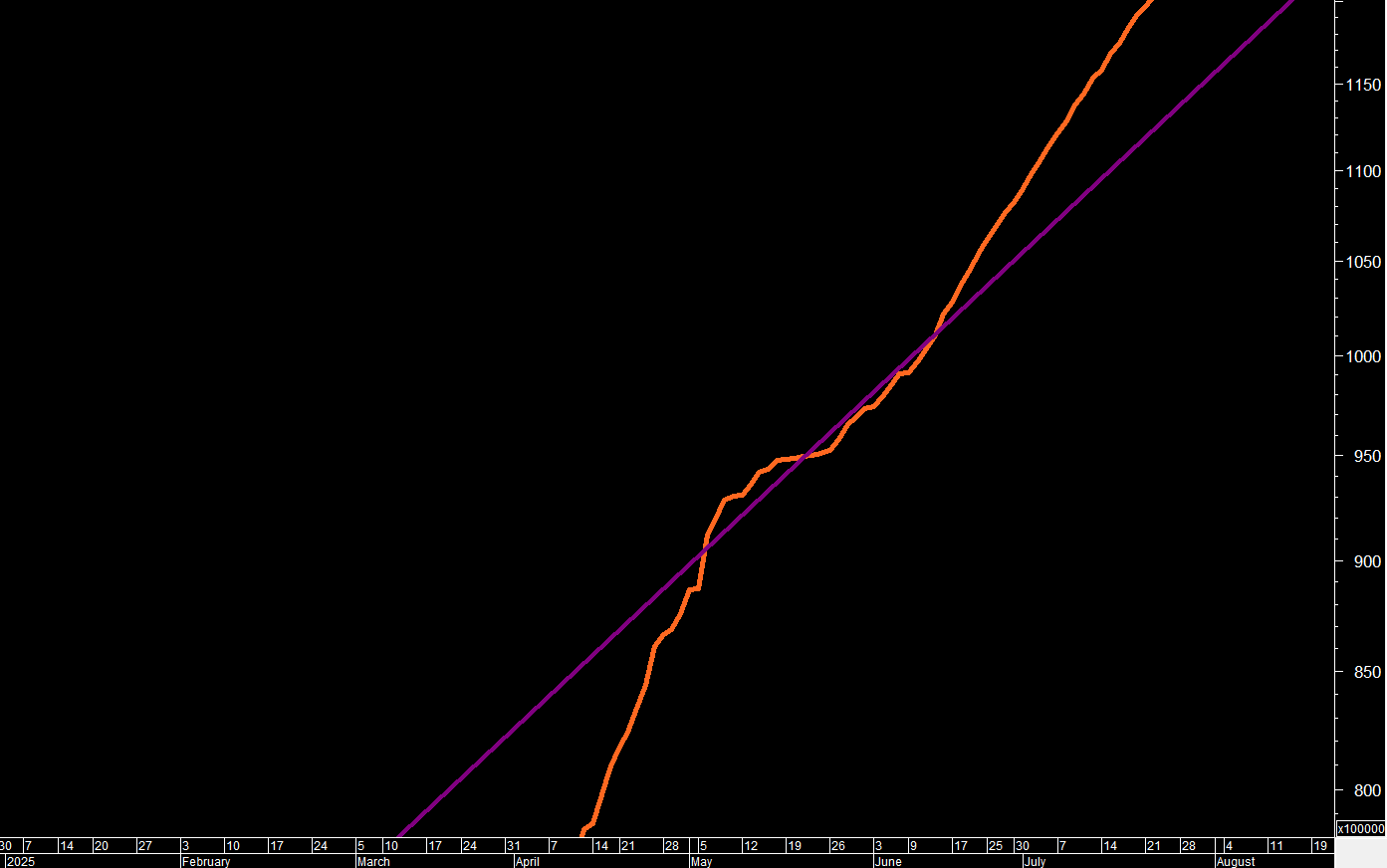
Note on the orange line in all charts referenced in this section: the orange line represents strictly the BCV official daily close rate. It does not illustrate the commercial banks' high or commercial banks' low. A candlestick chart would display all three data points separately.
From October 2021 to the present, these are the only three instances where the BCV official close rate spent more than 4–5 consecutive trading days at any given price level. Every other price point represents pure excess in Auction Market theory terms — price without sufficient time to establish value.
October 9–11, 2024 — The deliberate break: The BCV broke the value area balance with initiating moves of +1.23% (9 October) and +3.28% (11 October) — the first such moves in over a year. The post-October 2024 phase has produced no value area formation. The market is in continuous excess, consistent with deliberate BCV exchange rate management rather than organic market price discovery.
The forward-pricing function identified by Auction Market theory in the current Yadio–BCV premium has a direct historical precedent in the academic literature. Garay & González (2012) document that the discount between CANTV's local BVC price and its NYSE ADR price — which reached 50% in January 2004, immediately before the official February 2004 devaluation — constituted "the market's prediction concerning the expected future devaluation in the official exchange rate."
The parallel market of that era was pricing a monetary event the official rate had not yet acknowledged, just as the Yadio parallel market — running approximately 16% above the BCV official close as of 9 July 2026, after compressing from approximately 35% in May and June — is pricing a convergence event the official rate has not yet acknowledged. The mechanism is structurally identical across twenty years: the parallel market leads; the official rate follows.
4.4 The Chavez Trendline — Definition, Seven Interactions, and the Administered Exception
The purple logarithmic trendline — referred to throughout this research as the Chavez Trendline — is anchored from 2012 and tracks the underlying black market/parallel and official controlled monetary devaluation rate continuously across the entire dataset. It spans the DolarToday parallel rate era (2012–2019) and the BCV official close era (2019–present) without discontinuity.
The line's parameters are exact and reproducible: anchored at 9.94737 Bs.F on 17 August 2012 and passing through 296,749,248 (296.75 VED) on 22 June 2026 — 4,090 bars, a per-bar log slope of 0.0018276, and a calendar-equivalent structural rate of ×3.466 per year: the Bolívar's dollar price doubling every 6.7 months, sustained across fourteen years, two reconversions, and a regime change.
One methodological note is stated here so that no reviewer can raise it first: the line is drawn and extended in MetaStock bar space, and the dataset's bar frequency is not constant across its history (roughly 350–363 bars per year through 2018, weekday frequency thereafter). All deviations and forward values quoted in this section are therefore computed in the chart's own bar convention; the calendar-equivalent rate above is the anchor-to-anchor average.
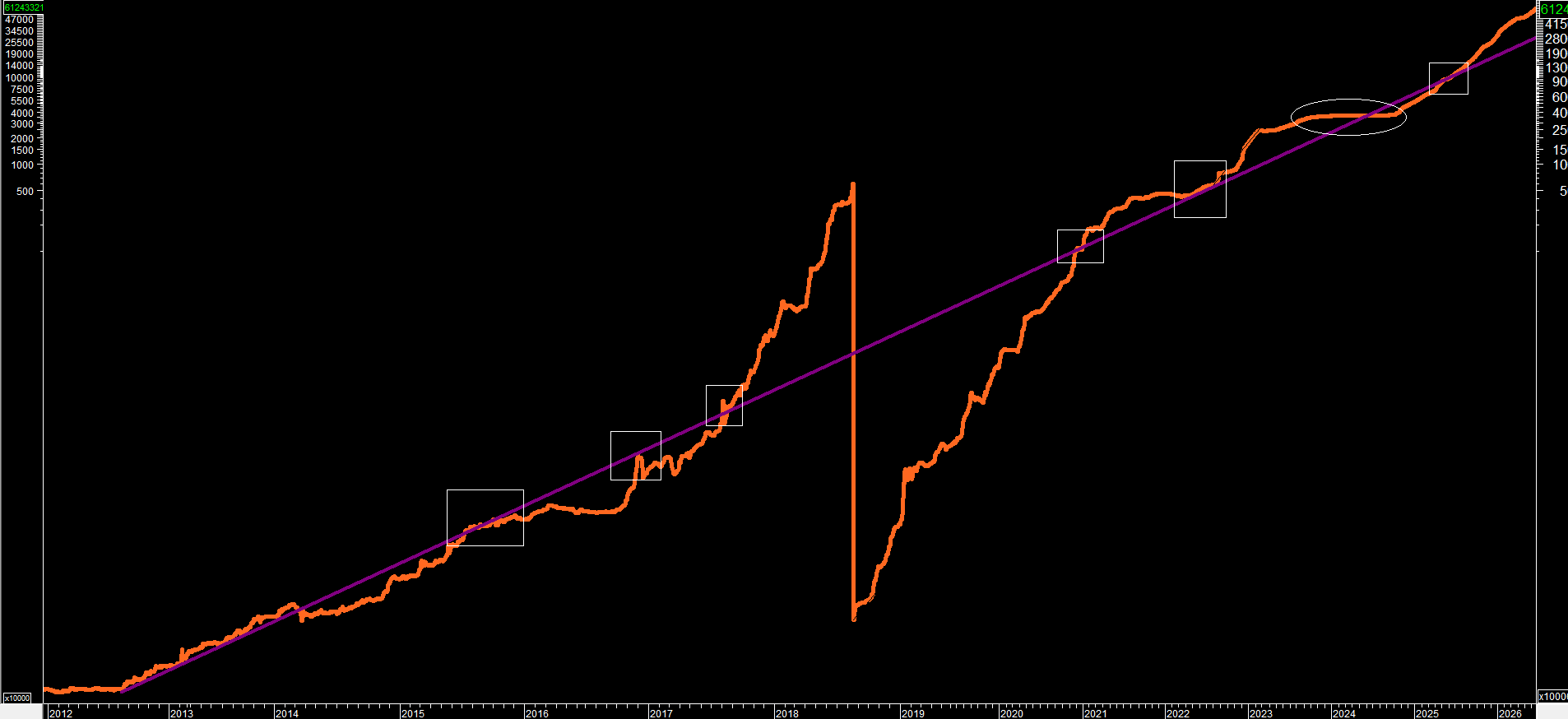
The trendline is anchored from 2012 for a substantive monetary reason — the April 2012 cessation of BCV parallel-market intervention, documented at the end of this section. The name commemorates a second, coincident event of the same political moment — Chávez's exhumation of Simón Bolívar's remains and the forensic facial reconstruction that created the version 2 portrait subsequently carried on all Goznak and Digital series notes — but the anchor's analytical validity rests on the intervention cessation, not the portrait.
The seven interactions. Measured against the line's exact parameters, the series has interacted with the trendline (within ±12%) in seven distinct episodes since the 2012 anchor:
| # | Period | Duration | Line level | Character |
|---|---|---|---|---|
| 1 | Jul 2012 – Mar 2014 | 620 days | ~23 Bs.F | Opening ride along the line from the anchor |
| 2 | Jul – Oct 2015 | 89 days | ~760 Bs.F | Approached from below; rejected back below |
| 3 | Aug – Sep 2017 | 33 days | ~15,700 Bs.F | Crossed from below — the hyperinflation launch through the line |
| 4 | Nov 2020 – Jan 2021 | 43 days | ~1.15M Bs.S | Post-reconversion recovery crossing, ending the 2018–20 undershoot |
| 5 | Mar – Aug 2022 | 170 days | ~4.9 VED | Approached from above; line held as support for five months |
| 6 | Apr – Jul 2024 | 87 days | ~36.4 VED | The administered exception — line passed through the frozen plateau, no price response |
| 7 | Apr – Aug 2025 | 134 days | ~108 VED | Approached from below; 15 May close within 3.5% of the line; upside break in late August |
(A correction to earlier versions of this research: the 2022 interaction was an approach from above with the line acting as support — not, as previously stated, a touch from below. Episode 7 subsumes and confirms the May 2025 recognition event: the line stood at 97.8 VED on 15 May 2025 against the documented close of 94.32.)
The administered exception, quantified. Episode 6 is the single violation in fourteen years, and its anatomy strengthens rather than weakens the line.
In October 2023 the rate sat 76% above the trendline; the BCV then held the rate administratively frozen at 36–37 VED — the October 2023–October 2024 value area identified in Section 4.3 — while the line rose through the stationary price (deviation −2.8% by June 2024) and out the other side, with no market response whatsoever.
The one period in which the trendline was ignored is precisely the period this research independently identifies as maximal BCV administration; and the mirror image sits at the line's origin, since Recchimurzo (2016) documents that the pre-April-2012 parallel rate was likewise suppressed by active intervention. The record therefore reads: the trendline is operative wherever price discovery operates, and suspended only where the rate is administered.
The current position, and its precedent. As of 9 July 2026 the rate stands 128% above the trendline (709.69 against a line value of 311) — the second-widest positive deviation of the post-reconversion era. The widest was +142%, on 9 February 2023, and its resolution is among the most instructive facts in the dataset: the deviation was closed not by a crash in the rate but by the administered plateau — the rate held flat while the ×3.466-per-year line climbed up beneath it, from +142% to −2.8% in sixteen months, without the price falling at all.
That episode is the historical template for Stage 2 of the appreciation model (Section 5.5): an announcement inside the 600–800 window followed by stabilisation closes the present deviation the same way — a rate held near current levels stands roughly 31% above the line by the 10 January 2027 inauguration (line ≈ 542 VED) and is overtaken by it entirely around April 2027, with zero further depreciation required.
What the trendline implies for the Stage 3 target. The 100–300 Bolívars per dollar target range (Section 5.4) sits 45–82% below the trendline at January 2027 — so the appreciation thesis is not a reversion-to-trend claim; it is a claim that the structural regime will be broken to the downside and held there.
Below-line regimes have precedent: the rate lived far beneath the line from the August 2018 reconversion until the November 2020 crossing (episode 4). But that excursion reverted upward for an identifiable reason — the 2018 launch was executed one year into US financial sanctions, with no reserve access, no gold, and no institutional backing.
Stage 3's claim is that the 2026 recirculation produces the first reserve-backed below-line excursion in the dataset's history, and the difference between the 2018–20 episode and Stage 3 is exactly the difference Section V documents: General License 57, the Bank of England gold, the IMF reserve tranche, and the restructuring. The trendline is thus the benchmark the recirculation must defeat, and its slope — ×3.466 per year — is the quantified cost of failure.
The Chavez Trendline confirms the thesis on three independent grounds:
First: The trendline spans both the DolarToday parallel rate era and the BCV official rate era continuously — confirming that the underlying devaluation dynamic did not change at any reconversion boundary, including October 2021.
Second: The trendline's May 2025 recognition event only exists in the unadjusted dataset. Had the six zeros been transposed, the BCV official close would never have reached the Chavez Trendline at any point without another 2017–2018 style hyperdevaluation episode. The trendline touch validates the author's analytical framework.
Third: The trendline was constructed from data beginning in 2012 — four years before the bulk note order, six years before the Soberano launch, and nine years before the 2021 re-expression — yet the series has interacted with it in seven distinct episodes across both currency eras and from both directions, including a 620-day opening ride and a five-month period as support, with a single exception that is fully explained by administration.
The claim is still stated with care: log-linearity as such is what any sustained inflation differential produces, and the line is used throughout this research as a structural reference level, not a predictive mechanism. But seven interactions with one administratively explained exception establish something specific: a persistent structural rate that every reconversion, re-expression, and relabelling has left untouched — the nominal continuity doctrine expressed in price rather than in law.
The intervention-cessation anchor is independently documented in the academic literature. Recchimurzo (2016) records — drawing on multiple Venezuelan economic consultancy sources — that until April 2012 the Venezuelan government actively intervened in the parallel foreign exchange market to suppress the premium between official and parallel rates, and that this intervention ceased in that month.
From April 2012 the parallel rate was free to price without institutional suppression, rising from approximately 9 Bs.F per dollar to over 800 Bs.F per dollar by December 2015 — approximately 9,000% over forty-four months of unmanaged discovery.
The trendline's anchor is therefore the year in which the Bolívar's long devaluation trajectory was released from active institutional suppression — which is why the line begins where free price discovery begins, and why its single violation (episode 6) occurs where administration returns.
The second rail — May 2019. A companion structural line exists on the banking-panel dataset (Section 5.2c; bibliography): anchored at the 17 May 2019 low and rising at approximately ×5.76 per year — the fast era's slope, against the primary trendline's ×3.47 — it has been touched at three separate episodes: the September 2024 highs, during the two-way fight that preceded the October re-slope; the capture-week Friday of 9 January 2026; and a nine-session cluster from late May to 10 July 2026, culminating in the panel High — the highest commercial-bank quote on the BCV's daily panel (Section 5.2c) — printing 778.0 on 10 July against a line value near 776 — the touch that turned the upper tier back (Section 5.2c).
Extended forward, this rail reaches 802.25 — the January reference high of Section 5.2b — on 20–21 July 2026. Price therefore sits between two structural rails: the fourteen-year line near 312 below, the seven-year line near 780 above, with the recirculation window occupying the gap — and the upper rail, the parallel value area high, and the window ceiling all arrive at the same coordinates in the same days.
4.5 The Parallel Premium, 2019–2025 — A Budget Gauge, Not a Fear Gauge
Three definitions, for the reader who does not live in markets.
The official rate is the exchange rate the BCV publishes each day; banks and licensed businesses must use it.
The parallel rate is the price Venezuelans actually pay one another for dollars outside those channels — and since roughly 2021 it is formed almost entirely on peer-to-peer (P2P) platforms, where users swap Bolívars for USDT, a digital token pegged one-to-one to the US dollar; the going price of those swaps is the parallel rate.
The premium is the percentage gap between the two: a parallel rate of 110 against an official rate of 100 is a +10% premium. Conventionally, the premium is read as a fear gauge — the wider the gap, the less the public trusts the official price. The evidence below shows that for Venezuela since 2022 this reading is wrong.
The dataset and the scoreboards. The author maintains a continuous daily parallel series from 13 May 2019 to 27 May 2025, archived alongside the primary dataset.
Its two sources are the two successive public "scoreboards" of the parallel market: DolarToday, the Miami-based reference whose publication of the rate ended on 10 October 2024, and thereafter the EnParaleloVzla3 average — an aggregate published twice daily at 9:00 a.m. and 1:05 p.m., itself compiled from DolarToday (while it lasted), several large P2P dealers, and Yadio — which ceased publication on 27 May 2025.
Each scoreboard was an iteration of the last; underneath both, the actual market was increasingly the Binance P2P order book, of which Yadio publishes a five-minute average — the series this research captures directly from March 2026 (Section 5.2a). Between the two lies a nine-month gap in the public record, to which this section returns.
First demonstration — the parallel rate had no expectations channel. A free market prices news the moment it arrives, and prices risk before it arrives. This series did neither. Four shocks, four readings from the tape:
| Event | Parallel response on arrival | Premium |
|---|---|---|
| Essequibo referendum (3 Dec 2023) | +1.0% over the fortnight; worst day +0.88% | pinned at ~+5% |
| Machado candidacy ban upheld (26 Jan 2024) | −0.8% | +6% → +5% |
| Opposition substitute blocked (late Mar 2024) | +1.1% | +6% → +7% |
| Disputed election and aftermath (28 Jul 2024) | −0.3% over three weeks | unchanged, ~+14% |
A war scare, two breaches of the Barbados Agreement that directly threatened the oil licence sustaining the currency's stability, and a disputed election with street unrest — four events any free emerging-market currency would have repriced within hours — printed approximately zero on arrival.
The responses came later, and only when physical dollar flows changed. Markets anticipate; administered prices react to their operator.
Second demonstration — the volatility signature. The parallel rate's daily volatility was 5.9% in 2019–20 and 2.3% through 2022. From mid-2023 it collapses to 0.67–0.75% per day and stays there through the entire October 2023 – October 2024 stabilisation — roughly one-eighth of the series' own free-era volatility, through all four shocks above.
The only cluster of large moves in that whole year is September 2024, when the tape shows alternating days of ±3% in both directions inside a rising market: the unmistakable footprint of a large seller leaning against the drift — a fight, visible for exactly the weeks before the stabilisation ended.
Third demonstration — the premium band tracks the US licence calendar, node for node.
| Date | Budget event | Premium band response |
|---|---|---|
| 26 Nov 2022 | OFAC General License 41 (Chevron) issued; $3B frozen-asset release framework agreed at the Mexico talks, same day | A band being lost through November (+6% → +20%) is recaptured to +7% within roughly ten trading days of the grant |
| 18 Oct 2023 | GL 44 (broad oil licence), the day after the Barbados Agreement | The stabilisation begins; mean band +6.4% for six months |
| 17 Apr 2024 | GL 44 lapses | Band erodes gradually to ~+11% — no step on the news months earlier, only on the flow |
| 28 Jul 2024 | Election aftermath | Zero on arrival; the September fight; then 9–11 October the configuration is changed — the official moves from flat to a smooth 0.6%-per-day crawl (0.34% daily volatility) and the band is re-pinned near +21% |
| 26 Feb 2025 | Chevron licence termination announced | Spike to +28%, defended back to +19% by 10 March |
| late Mar – 4 Apr 2025 | Initial wind-down deadline approaches; extension granted | Band breaks to +47%; snaps back to +35% on the days of the extension |
| 19–27 May 2025 | Final wind-down deadline (27 May) | Defence abandoned: +26% → +49% in seven sessions, the final print landing on the deadline day itself |
| Jun – Dec 2025 | Post-deadline: licensed flow at zero | The band becomes uncompressible and floats at +32% to +65% for seven months — through the naval deployments of the autumn, during which it narrows (+55.6% September mean to +42.7% November) |
| 5–9 Jan 2026 | Regime transition | A 72-hour spike to +142% — the market pricing the no-manager state — is crushed to +40% within three weeks by the incoming administration, the fastest compression in the record |
| 14 Apr 2026 | General License 57 — full BCV unblocking | The band compresses from the transition era's 40–60% through the spring — roughly +30% across June — to +10% to +15% by mid-July |
Read as one object: across two US administrations, every step in the premium corresponds to a change in the Venezuelan state's convertible-dollar budget — capacity granted (November 2022, October 2023), capacity eroded (April 2024), capacity burned (August–October 2024), capacity withdrawn (February–May 2025) — while every purely political shock printed nothing.
Even the Barbados breaches mattered only through the single channel geopolitics has in this system: they caused the licence lapse, the lapse cut the flow, and the flow moved the band, months later. The premium is not a fear gauge. It is a budget meter.
Fourth demonstration — the fix that did not flinch. The recovered record of the transition itself (Section 5.2b) supplies the strongest exhibit of all.
Between 5 and 9 January 2026 — capture, extradition, parade, and change of government — the BCV official rate printed 308 to 342 on its scheduled crawl of roughly one percent per trading day, with no deviation whatsoever, while the parallel rate spiked 140% beside it.
Every demonstration above shows the parallel ignoring news; this shows the official ignoring the fall of the government that appointed its board. There is no stronger evidence of an administered system anywhere in this record.
Why the usual run mechanics do not exist here. Two structural facts close the loop.
First, there is no stock to run: Venezuelan savings dollarised years ago, permanently, and Bolívar holdings are transactional float measured in hours — payroll in, taxes and utilities out, obligations that must legally clear in Bolívars. The country's entire physical cash stock is about $136 million (Section 2.5); the public cannot panic-sell an asset it does not hold overnight.
Second, the state operates inside the venue itself: whatever convertible revenue or released external assets it obtains must be converted into Bolívars to be spent, and the conversion happens through the same P2P complex that forms the parallel price — the state's routine treasury operation is intervention. An operator stripped of every conventional instrument manages what remains — prices, information, records; this memorandum documents that capability as adaptation, not as indictment.
The candidate funding pools are documented to exist even where their use is not: licensed oil revenue under GLs 41 and 44; the 26 November 2022 release framework over frozen external assets, a family that includes the blocked BCV balances in New York left by the 2019 Citibank gold-swap execution and the August 2019 blocking order; and, per 2024 investigative reporting, PDVSA sales settled directly in USDT through intermediaries — revenue arriving already denominated in the venue's own settlement asset. Which pool funded which defence cannot be read from price data. That capacity arrived on the agreement dates can — to the week.
The information environment. Two scoreboards, two jurisdictions, one pattern.
DolarToday — Miami-based, beyond Caracas's coercive reach, as the BCV's own failed 2015 US lawsuit established — went dark on 4–10 October 2024, the exact window in which the year-long stabilisation was broken, and returned without its rate.
EnParaleloVzla3 ceased on 27 May 2025 — the Chevron wind-down deadline day, at the widest premium the aggregate scoreboards ever printed — amid reported detentions of rate monitors inside Venezuela. What followed was not darkness but demotion: no successor of comparable prominence emerged, and the parallel record survived only in smaller venues — this research reconstructs the June 2025 – March 2026 period from the Telegram channel valorcambiario (see bibliography), with the Binance P2P book, read through Yadio, becoming the de facto price source.
The reconstructed record shows what the acceleration of late 2025 actually was: not an official catch-up to a stationary target, but a double climb — the parallel rose from 133 in June to 423 in December, the official from roughly 100 to 274, and the premium never closed, floating between +32% and +65% across the seven months in which no licensed dollar flow existed to compress it.
Transitions, in this record, are executed when prominent independent measurement is absent. Whether that is design or coincidence is left to the reader; the dates are the dates.
What this means for the thesis. Three things.
First, it reframes the premium-expansion risk in Section 5.7: across six years this premium never blew out on sentiment — it moved when, and only when, the budget moved — so the true risk to the convergence pathway is reserve capacity, which is exactly what Section V's pillars address and what General License 57 has now unblocked in full.
Second, Stages 2 and 3 of the appreciation model require no new institutional capability: the state has administered this parallel venue continuously since late 2022, through a licence loss, a disputed election, and a regime change — the toolkit the projection assumes is built, staffed, and battle-tested in the very market where Yadio prices today.
Third, the current Yadio band of roughly +10% to +15% (Section 5.2) is the tightest sustained premium since the GL 44 window — exactly where a budget meter should sit in the first period of full central bank unblocking — and it supplies a forward tell, added to Section 5.8: a re-targeting of the band, or interference with the last remaining scoreboard, is the kind of event that has preceded every major transition in this record.
SECTION V: THE CONVERGENCE THESIS
The preceding four sections have established four independent pillars supporting the recirculation thesis: the legal mechanism exists
(Section I); the physical inventory is documented and preserved (Section II); the secondary market confirms the inventory's quality and the BCV's probable operational behaviour (Section III); and the trading data provides structural confirmation of the nominal continuity doctrine (Section IV). This section synthesises those pillars into a convergence thesis: all of the institutional, legal, physical, and market conditions necessary for a Bolívar recirculation have now aligned simultaneously for the first time since the imposition of US financial sanctions in August 2017.
5.1 The Institutional Context — Spring 2026
Five institutional events between April and June 2026 have created the enabling conditions. Each is individually significant. Together they constitute a coordinated normalisation sequence.
| Date | Event | Significance |
|---|---|---|
| 1 Apr 2026 | OFAC removes Rodríguez from SDN | Political recognition pathway opens. |
| 14 Apr 2026 | OFAC General License 57 | GL 57 authorises financial services transactions involving the BCV — wire transfers, currency exchange, correspondent banking. Self-executing only when all conditions met; must be read narrowly. |
| 30 May 2026 | IMF MD meets Ortega in Washington | First in-person IMF-Venezuela meeting since engagement resumed. |
| 5 Jun 2026 | IMF appoints Venezuela mission chief | Álvaro Piris Chavarri. Article IV pre-consultation groundwork underway. IMF not yet involved in debt restructuring itself (per IMF spokesperson Kozack). |
| Ongoing | 2031 bonds: 10¢ → 57¢ | Bond market pricing in normalisation. 470% rally since Maduro's capture. |
Important qualification on the sanctions framework: The BCV sanctions lift is real but nuanced.
Venezuelan oil revenue — the primary source of hard currency — flows into US Treasury deposit funds under Executive Order 14373, with the Secretary of State controlling disbursements. Venezuela submits monthly budget requests for State Department approval to receive its share. The general licences can be revoked at any time.
The recirculation of existing vault stock is operationally independent of this framework — it requires no new international payments and no State Department approval. New print orders from European printers would require accessing supervised funds.
Additionally, OFAC General License 56 — which covers commercial contract negotiations with the Government of Venezuela — expressly excludes payments in gold and transactions denominated in digital currency. Any new print order contract or gold-related transaction would therefore likely require a separate specific OFAC licence beyond the existing general licences.
On the IMF's actual knowledge: The January 2026 official data baseline is the BCV's public record. The IMF's working knowledge through bilateral consultation almost certainly extends substantially beyond it. The significance of the BCV's statistical erasure is therefore not that it deceives the IMF — it is that it creates the official institutional narrative within which any recirculation can be framed as forward-looking monetary policy rather than a redeployment of legacy inventory.
On the IMF's actual role: The IMF engagement as of June 2026 is capacity development and pre-consultation groundwork — not a conventional IMF-supervised monetary recovery programme. IMF spokesperson Julie Kozack explicitly confirmed at the 30 May meeting: "On the debt — the Fund is not yet involved in those discussions on the debt restructuring." What exists is preliminary technical assistance and the groundwork toward an Article IV consultation. Venezuela has not completed an Article IV review since 2004. A recirculation decree alongside a commitment to data transparency would give the IMF the framework it needs to deepen engagement — but the IMF's role in the restructuring itself remains limited at this stage.
On the broader US oversight architecture: the June 2026 OFAC licence framework reinforces the structured nature of US oversight of Venezuelan economic activity. Updated general licences issued 10 June 2026 introduce mandatory US-law contract governance for transactions with the Venezuelan government and PdVSA, reporting requirements to US government agencies detailing counterparties, transaction values, and payments made to the Venezuelan government, and explicit exclusions of Chinese and Russian-linked entities from authorised Venezuelan commercial activity.
This framework suggests the US is building a permanent oversight architecture for Venezuelan economic flows rather than a temporary transitional arrangement — consistent with the EO 14373 oil revenue deposit fund structure already documented in this section.
The pace of operationalisation of this framework is notable.
SLB — the world's largest oilfield services company, with 97 years of uninterrupted presence in Venezuela — signed a long-term MoU with PDVSA on 10 June 2026, the same day the updated OFAC licences took effect.
Shell signed a licence agreement for the cross-border Loran gas field on 11 June 2026, with Acting President Rodríguez leading the signing at Miraflores Palace — a British company concluding a major commercial agreement at the seat of Venezuela's government, a form of implicit political recognition that runs parallel to the formal recognition arguments documented in Section 1.9.
This is the June 2026 OFAC framework being converted into commercial agreements in real time.
The monetary recirculation thesis sits within the same normalisation trajectory: a BCV that can now transact with Western financial institutions under GL 57 is operating in an environment where Western commercial engagement with Venezuelan state entities is actively being structured, supervised, and operationalised.
The recirculation mechanism does not require the oil sector framework — but the two form part of the same coordinated reintegration of Venezuela into a US-supervised Western commercial order. Any future supplementary print contracts with De La Rue, G+D, or Oberthur Fiduciaire would similarly need to comply with the mandatory US-law contract governance and dispute resolution requirements introduced in the June 2026 licence framework — a compliance requirement, not a prohibition.
On 11 June 2026, Venezuela retained Greenberg Traurig, a major US law firm, to lead its representation in the Crystallex arbitration enforcement proceedings in US courts. This engagement is a signal of Venezuela's active participation in US legal proceedings under the post-Maduro institutional framework, and is consistent with the broader normalisation trajectory documented in this section. The Crystallex enforcement proceedings involve claims against Venezuelan state assets in US jurisdiction — the resolution of which forms part of the wider sovereign creditor picture relevant to any debt restructuring.
The bond market evidence deserves specific elaboration. Venezuela's 2031 dollar bonds traded at approximately 10 cents per dollar of face value at the time of Maduro's capture. By early June 2026 they trade at approximately 57 cents — a 470% rally in five months. Funds holding these bonds have made multi-million-dollar bets that Venezuela is moving from monetary collapse toward normalisation. Their conviction is expressed in market price, not in commentary.
One important sequencing note: on 13 May 2026, Venezuela announced its intent to commence sovereign debt restructuring via Centerview Partners — before the thesis's projected recirculation window, before IMF involvement in the restructuring, and without monetary stabilisation as a precondition. The thesis originally projected debt restructuring as a consequence of monetary normalisation; in practice it has been announced as a parallel or prior process.
This does not undermine the recirculation mechanism — but it means the recirculation, if it occurs, would follow rather than precede a debt restructuring announcement. Additionally, independent analysis notes that vulture funds are now among Venezuela's largest creditors, and the bond rally may partly reflect creditor optimism about extracting favourable out-of-IMF restructuring terms rather than purely a signal of sovereign monetary recovery.
Both interpretations of the rally are analytically defensible; this research prefers the normalisation reading while acknowledging the alternative.
Calixto Ortega is the pivotal figure connecting Section I's legal architecture to this institutional moment. He designed the entire August 2018 monetary framework — Convenio Cambiario N° 1, the Soberano reconversion, and the Article 2 mechanism that underpins this thesis.
He served as BCV President from June 2018 until February 2023. In a public interview in early 2026, Ortega explicitly drew on his BCV tenure as the foundation of his current institutional credibility, described the 2024 monetary stability as a deliberate achievement of the framework he built, and characterised Venezuela's path to recovery in the language of access to its own monetary assets: "it was we didn't have access to our own money [sic]... if you allow us to function like a regular country Venezuela will show an extraordinary improvement." He now serves as Economy Vice President and attended the 30 May 2026 IMF meeting alongside current BCV President Luis Pérez.
The recirculation mechanism is precisely the pathway Ortega describes — deploying Venezuela's own pre-paid physical monetary assets without requiring access to supervised oil revenues or new international payments. The execution of a recirculation resolution would require action by the current BCV Board under President Luis Pérez, appointed by Rodríguez days after sanctions were lifted — conditions more consistent with executive alignment toward the recirculation mechanism than with institutional discontinuity.
5.2 The Rate Projection — The 600–800 Window
The following rate log tracks the BCV official close through the 600–800 recirculation window.
The record is presented as weekly Friday closes — the BCV official close paired with the Yadio close of the same day (23:59:59 UTC cut-off, several hours after the BCV's evening publication, so the parallel print reflects the market's reaction to that day's official rate) — followed by a daily block for the current week only. Full daily and five-minute datasets are retained in the author's archive, available on institutional request via the publisher (migp.ca).
| Friday | BCV Official | Yadio (≤18:00) | Premium |
|---|---|---|---|
| 13 Mar 2026 | 446.805 | 624.84 | +39.8% |
| 20 Mar | 457.076 | 655.71 | +43.5% |
| 27 Mar | 471.700 | 662.99 | +40.6% |
| 3 Apr | — (holiday) | 638.28 | — |
| 10 Apr | 477.149 | 636.39 | +33.4% |
| 17 Apr | 481.218 | 618.82 | +28.6% |
| 24 Apr | 484.740 | 628.14 | +29.6% |
| 1 May | — (holiday) | 631.15 | — |
| 8 May | 500.461 | 648.60 | +29.6% |
| 15 May | 517.962 | 687.21 | +32.7% |
| 22 May | 530.505 | 718.41 | +35.4% |
| 29 May | 554.426 | 729.35 | +31.6% |
| 5 Jun | 567.683 | 757.14 | +33.4% |
| 12 Jun | 587.406 | 793.34 | +35.1% |
| 19 Jun | 612.433 | 801.33 | +30.8% |
| 26 Jun | 623.022 | 770.58 | +23.7% |
| 3 Jul | 667.050 | 748.10 | +12.2% |
| 10 Jul | 721.346 | 822.65 | +14.0% |
| 17 Jul | 736.934 | 837.13 | +13.6% |
The current week, daily — the defence-branch watch:
| Date | BCV Official | Daily Δ | Yadio close | Premium |
|---|---|---|---|---|
| Mon 13 Jul | 723.999 | +0.368% | 820.62 | +13.3% |
| Tue 14 Jul | 725.747 | +0.241% | 835.15 | +15.1% |
| Wed 15 Jul | 727.451 | +0.235% | 831.15 | +14.3% |
| Thu 16 Jul | 732.479 | +0.691% | 816.71 | +11.5% |
| Fri 17 Jul | 736.934 | +0.608% | 837.13 | +13.6% |
The BCV official close crossed 600 VED on 17 June 2026 — the projection from late May proved accurate to the day. The rate decelerated sharply in the final week of June — +0.11% and +0.13% on 25–26 June — before accelerating dramatically from 30 June onward.
The BCV official close crossed 700 VED on 8 July 2026, just 21 days after crossing 600 — a 100-Bolívar move in three weeks. The +2.156% increment on 3 July and +2.081% on 8 July are the two largest single-day moves in the log.
The Article 234 political deadline of 2 July 2026 fell precisely within the sharpest acceleration sequence the dataset records. The panel High crossed 800 for the first time on 9 July (801.900) before easing to 778.000 on 10 July, while the BCV official close crossed 720 on 10 July (721.346, +1.642%). On Monday 13 July the daily step decelerated sharply to +0.368% (723.999) while the commercial hi–lo spread collapsed from 12.4% to 2.4% — the banking-panel convergence analysed in Section 5.2c.
The commercial banking market crossed 600 VED substantially ahead of the BCV official rate. On 3 June 2026, Banco Venezolano de Crédito posted a venta rate of 632 VED. The panel High series — the daily commercial banking system high — crossed 700 on 9 June and reached 779.867 on 11 June, a level 34% above the same-day BCV official close of 582.686.
This spread reflects the BCV official rate's construction as a weighted mean of all participating bank quotations, which lags the leading edge of the commercial market.
The window arithmetic — stated as a falsifiable implication. From 26 June (623.022) to 13 July (723.999), the BCV official close compounded at approximately 1.37% per trading day. At that velocity, the official rate exits the upper bound of the 600–800 recirculation window in approximately seven further trading days — on or about 22 July 2026.
The 13 July print, however, decelerated to +0.368% with the banking panel converging in the same session (Section 5.2c); if that deceleration is sustained, the operative branch of falsification criterion 4 (Section 5.8) is not exhaustion but defence — the rate held inside the window by visible management, which is itself an action confirming the window's significance. (Re-timed, as of 16 July: the crawl resumed at +0.691% — the canonical 2024–2025 slope — which lands the 800 exit on 3–4 August; Sections 5.2c and 5.3.)
The Yadio parallel rate, the closest available proxy for the market-clearing price, has printed above 800 — though the market profile analysis in Section 5.2b reads those prints, for now, as unaccepted excess above a confirmed value area rather than an established breakout.
The thesis is therefore now making a specific, dated, falsifiable claim, and it is stated here deliberately rather than avoided: at prevailing velocity, a recirculation announcement consistent with this memorandum's window occurs by approximately the third week of July 2026, or the window lapses — in which case this research must account for why the BCV allowed it to pass, whether by identifying a deliberate deceleration of the official crawl (itself a detectable BCV action), a widening of the window this research has misjudged, or a re-rating of the thesis itself.
Section 5.8 sets out the falsification criteria in full.
Why 800 is the ceiling. The upper bound is the market's own number. Profile 3 of the Yadio market profile analysis (Section 5.2b) defines the parallel market's current confirmed value area as 766.15–828.15, with the point of control at 791.31; the 800 window bound sits inside that value area, just above the point of control, and the value area high brackets the convergence zone from above.
Below it, an announcement lands inside the range the market has already accepted as fair value; above the value area high, the announcement would chase a price the market itself has not yet accepted — every excursion above it, including the 859.44 high of 15 July, has so far resolved as excess. The boundary is a living one — the profile is cumulative, and its value area moves as trade accrues — and it is conditional in a stated, observable way: sustained acceptance above the value area high, with the point of control migrating upward, would move it, which is precisely falsification criterion 4 of Section 5.8.
Three secondary considerations reinforce the same bound. Ladder utility: above 800 the 20,000 Bs.F — the top of the proposed ladder — falls below $25, and the denomination structure begins to repeat the inadequacy that destroyed the Fuerte's usefulness in 2017.
Appreciation credibility: from within the window the move to the 100 target is six-to-eight-fold; from materially above 800 it approaches an order of magnitude. Announcement optics: a recirculation announced into visible downward acceleration reads as desperation rather than design.
5.2a Yadio Parallel Market — Premium Compression
Yadio is the successor reference in the scoreboard lineage documented in Section 4.5 (DolarToday to October 2024, EnParaleloVzla3 to May 2025, then the Binance P2P book directly).
A supplementary parallel market series — the Yadio USD/VES rate, sourced from the real-time P2P aggregator at api.yadio.io — provides an independent measure of market-clearing rates outside the BCV-supervised banking system. The full dataset covering 6 March 2026 to 10 July 2026 (35,755 five-minute observations) documents a development of direct analytical significance: the Yadio–BCV premium has compressed sharply and rapidly since mid-June.
The paired weekly record now lives in the combined table of Section 5.2; the narrative below tracks its inflection points.
The Yadio–BCV premium compressed sharply from 30.8% on 19 June to a low of 12.2% on 3 July, driven by the BCV official rate accelerating faster than the parallel market. The premium then re-expanded as the Yadio market broke sharply higher from 6 July onward — rising from 743.50 to 822.54 in three sessions (+10.6%) — while the BCV official rate continued its more measured climb.
The net effect is a premium that has stabilised in the 10–15% range rather than converging to single digits as the 3 July data briefly suggested. Both series are moving upward simultaneously, but Yadio re-accelerated first. At the current Yadio level of approximately 822 and BCV official of approximately 710, the premium stands at roughly 15.9% — a significant contraction from the ~35% documented in earlier versions of this thesis, and still low by Venezuela's historical benchmarks, but no longer compressing at the velocity seen in late June.
The most notable Yadio event in this window came on 8–9 July, when the parallel market broke to 814.71 on 8 July and then to a new dataset high of 830.65 on 9 July — marginally exceeding the prior high of 827.98 set on 11 June — before trading 824–828 on 10 July (partial day). Whether these prints constitute excess above value or acceptance at a new level is analysed in Section 5.2b.
5.2b The Yadio Parallel Market — Auction Structure: Three Balance Areas and a Managed Crawl
The Yadio parallel series provides an independent structural corroboration of the Auction Market analysis conducted on the author's 7,314-day institutional dataset in Section IV — but of a more precise kind than earlier versions of this research recognised. TPO market profile analysis of the full March–July series resolves it into three successive balance areas — the classic auction sequence of bracket, directional break, and new bracket at a higher level:
| Profile | Period | Value area | Point of control | Range |
|---|---|---|---|---|
| 1 | 6 March – 14 May | 618.10 – 654.42 | 628.16 | 596 – 678 |
| 2 | 14 May – 5 June | 698.16 – 736.80 | 729.43 | 666 – 747 |
| 3 | 5 June – present | 766.15 – 828.15 | 791.31 | 721 – 859.44 |
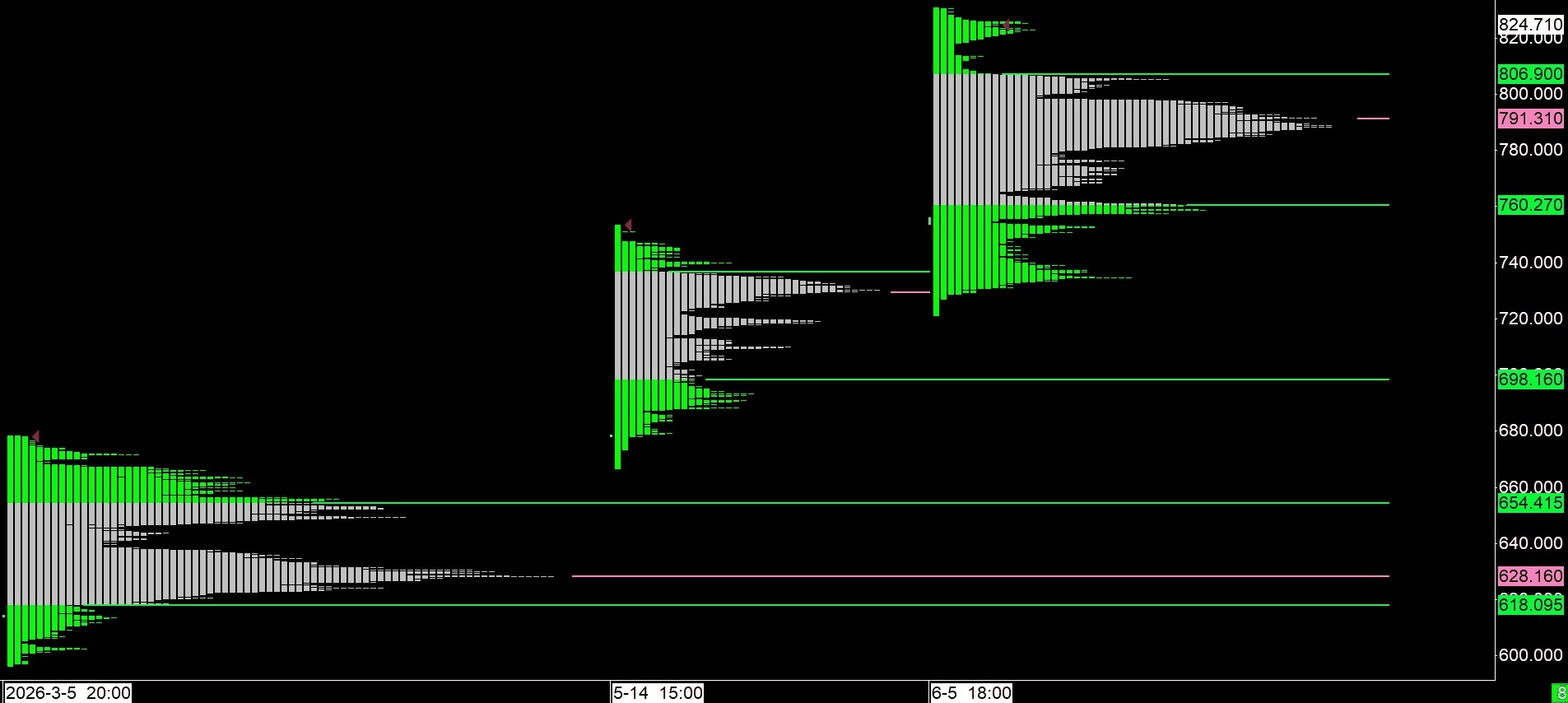
All three profiles are taken from the author's MetaStock TPO analysis (Figure 4). An independent check — a frequency-of-price analysis computed directly from the raw five-minute series using a different profile construction — reproduces the TPO levels closely (Profile 1: 617/630/654; Profile 2 point of control: 729.5 against the TPO 729.43; Profile 3: 758/795/808), confirming that the balance areas are properties of the data, not artefacts of one charting methodology.
Within each bracket, the parallel rate rotated repeatedly back to its point of control — genuine two-sided auction behaviour, with reversion to the mean inside each balance and directional excess confined to the transitions between them.
The largest intraday event of the series — the 19 May 2026 flash decline to 666 followed by recovery to 701 at close — resolved within a single session back into the prevailing structure, as balanced markets do. This corrects the characterisation in earlier versions of this research that the Yadio series exhibited no value formation: it has formed value three times, at successively higher levels, and it has respected each value area while it lasted.
The structural contrast with the official series is the analytical point. Over the same four months, the BCV official close has exhibited almost no mean reversion at any timeframe — a monotonic managed crawl with no value area formation, continuous with the post-October 2024 behaviour documented in Section 4.3, with daily increments episodically exceeding 2%.
The same currency is therefore trading in two different market structures simultaneously: the parallel market auctions — it balances, breaks, and rebalances — while the official rate is administered. This corroborates Section 4.3's deliberate-management finding from a fully independent data series, and it settles which of the two rates is performing price discovery: Yadio auctions the Bolívar; the BCV publishes it.
The current position within this structure: the prints above 807 — the 11–12 June excursion to 827.98, and the 8–10 July excursion to a new dataset high of 830.65 — are probes above the value area high that have not, so far, been accepted. Time-at-price above it remains thin, the point of control has not migrated, and the first excursion (11–12 June) resolved by rotating back through the point of control — the auction advertising above value, finding sellers, and returning.
Under Auction Market rules the base case, until acceptance is demonstrated, is a further rotation toward the 791.31 point of control. Acceptance — value building above the 828.15 value area high, the point of control migrating upward, and the boundary flipping from resistance to support on retest — would instead signal a fourth, higher balance forming, and is directly observable in the profile as it develops.
The convergence implication is specific. If Profile 3 holds and the parallel rate rotates toward its point of control while the official crawl runs at its pre-13-July velocity, the BCV official close arrives in the low 790s on or about 21 July 2026; at the parked velocity of 13–16 July, that meeting recedes toward late August — the two-calendar structure of Section 5.3 — independently the same date the window arithmetic of Section 5.2 produces from the official series alone.
Convergence would then occur inside the parallel market's own confirmed value area: a Stage 1 announcement made at a price the market has already accepted as fair value, rather than across a live premium — the cleanest configuration available to the sequencing this thesis describes. The premium's path since 30 June — compression to 12.2%, then re-expansion into a 10–15% band as Yadio probed above value — is the same structure viewed through the spread: the band resolves toward zero if Profile 3 holds, and re-widens if acceptance above the value area high establishes a fourth balance.
The profile, not the premium alone, is now the live indicator to watch.
The January reference high. The reconstructed Binance P2P record (Section 4.5; bibliography) gives the current test of the 800 zone a precise ancestry. In the seventy-two hours around the change of government — 5 to 9 January 2026 — the P2P market spiked from 660 to a daily close of 776, with intraday prints above 800 observed directly by the author, against an official fix near 320: a momentary premium of +142%, the widest in the seven-year record.
It was the market's instantaneous pricing of the no-manager state, and it lasted three days. The incoming administration crushed it — the parallel fell 43% to 444 by 19 January while the official continued its scheduled crawl — and the market then rebuilt: 516–540 through February, 614 by month-end, handing off at 609 to the Yadio series that opens Profile 1 at 618 four days later. Every balance area since has formed above the last: 618–654, 698–737, 766–828.
Read together, the sequence is striking: the market's three-day panic estimate of the Bolívar's unmanaged price was roughly 800; the managed regime then spent five months walking the price back to precisely that zone through orderly, ascending value areas. The current test of 800–830 is not an excursion into new territory — it is the administered price arriving at the market's own January estimate. This supplies the window ceiling of Section 5.2 with a third independent derivation: the January reference high (~802 intraday), the second rail's arrival at 802.25 on 20–21 July (Section 4.4), and the 800 window bound — three numbers from three methods inside one percent of each other, with the composite profile's living value area high (828.15) bracketing the zone from above.
Status of the acceptance test (dated: Friday evening, 17 July, after the BCV print). The week posed the question and answered it. Five sessions traded almost entirely above the old value area high, reaching 859.44 on the 15th, and the working hypothesis of a fourth balance forming at 810–840 was live through Friday afternoon. The composite profile resolves it the other way.
Read against the full profile accumulated since 5 June — value area 766.15–828.15, point of control 791.31 — the week's action never left home: the 12th–13th filled a low-volume node inside value, the 15th's excursion above the value area high was rejected the same session, the 16th touched value and bounced, and Friday, after printing 837.13 at the UTC close, faded to 830 on the evening's official publication — back to the value area high itself. A genuine breakaway trades outside the prior profile and stays there, even thinly; this market was offered the exit twice and declined it. The verdict recorded here: the July highs are excess at the top of a growing value area, not a new balance; the point of control has not migrated; criterion 4's ceiling condition is not triggered.
The convergence geometry therefore sharpens rather than moves. The official, two sessions into the re-timed canonical crawl (+0.691%, +0.608%), reaches the 800 bound on 3–4 August; the parallel balances just above it, the Friday pair closing at a premium of +13.6%; and the fixed derivations — the 800 bound, the ~802 January reference, the second rail's 802.25 arrival on 20–21 July — hold their coordinates inside one percent of each other, bracketed from above by the living boundary at 828. The resolution stands recorded, and the boundary remains under weekly review.
5.2c The Banking Panel — A Two-Tier Official Market and the 13 July Convergence
The BCV publishes a daily panel of indicative per-bank exchange rates (tasas informativas del sistema bancario — see bibliography), five institutions plus an aggregate per day, from May 2019. Parsed in full, the panel adds a microstructure layer to the rate log above. Through 2024 the panel quoted effectively one price: the average spread between the highest and lowest bank quote was 0.8% for the year, and just 0.3% in the weeks before the October 2024 re-slope — total discipline.
In 2025 it loosened to 2.1%. With the January 2026 transition it fragmented: 9.1% in January and roughly 20% from February through June — a two-tier official market, with the large incumbents (BBVA Provincial, Mercantil, Banesco, BNC) pinned to the BCV fix while a second tier of smaller institutions (R4, Bancaribe, Banco Plaza, 100% Banco, Banco Exterior) quoted 15–22% higher, at parallel-adjacent levels, inside the regulated system. The convergence this thesis projects was, on this evidence, already occurring bank by bank through the first half of 2026 — and the panel High was never an outlier quote: 9 July's 801.9 was Bancaribe; 10 July's 778.0 was 100% Banco.
On Monday 13 July the two tiers were welded shut. The daily spread collapsed from 14.5% (8–9 July) and 11.1% (10 July) to 2.1%, the whole panel converging into 719–737 in a single session — and the high quotes came down to the floor rather than the floor rising to meet them. In the same session, the official's daily step decelerated to +0.368% from the +1.4–2.1% of the preceding week.
Three gauges therefore moved together into one configuration: crawl velocity decelerating, panel dispersion welded to a single price, and the Yadio premium at 10–15%, the tightest since the GL 44 window. If sustained, this is the defence branch of falsification criterion 4 (Section 5.8) — and it is also, precisely, the pre-announcement configuration this memorandum describes: a single official price, a compressed premium, and the rate inside the window, below the parallel market's point of control.
One further observation, stated with its caveat. Banco de Venezuela — the state's largest retail bank, historically a sparse presence on the panel at roughly three quotes a month — printed its last quote in the file on 14 April 2026, the day General License 57 was issued, and has been absent through the entire two-tier period and through the 9 July change of its presidency (Section 5.1). The panel's membership rotates editorially, so absence is suggestive rather than conclusive; but the state bank has shown no public price since the day the BCV was unblocked.
The weld, re-timed — 16 July. The configuration above held for exactly the three parked sessions. On Thursday 16 July the official resumed at +0.691% (732.479) — almost precisely the canonical managed-crawl slope of the October 2024–2025 era — while the panel spread reopened to 9.1%: Bancaribe returned to the upper tier at 793.9, within half a percent of the second rail of Section 4.4, and the panel Low held at 727.5.
Read together, the three-day park was not a halt that failed but a re-timing operation: at the resumed slope, the official reaches 800 in roughly thirteen trading days — 3–4 August — landing the window's exhaustion directly on the 1 August joint-framework date and the 4 August activation of General License 5X. The two calendars of Section 5.3 are no longer in tension; they have been synchronised. Friday's print confirmed the slope — +0.608% (736.934), a second consecutive session on the canonical crawl — and the panel posted a further tell: Bancaribe, the upper tier's leader and the second rail's most faithful rider, was absent from the Friday file altogether, the panel High falling to Mercantil's 775.97 against its own 732.47 compra. The caveat that attends Banco de Venezuela's absence applies here too — the panel rotates editorially — but the pattern of exits at junctures is accumulating.
5.3 The Constitutional Context — Article 234 and the TSJ Hybrid Ruling
Article 234 of the Venezuelan Constitution limits a president's temporary absence to 90 days, extendable once by the National Assembly for a further 90 days — a maximum of 180 days total. Maduro's capture on approximately 3 January 2026 would place the extended 180-day limit at approximately 2 July 2026.
However, the TSJ Sala Constitucional's Sentencia 0001 of 3 January 2026 created a hybrid "exceptional circumstances" interpretation, describing the situation as "atypical and force majeure not literally provided for in the Constitution," and ordering Rodríguez to assume presidential attributes without formally declaring a falta temporal or falta absoluta. This suspended the constitutional clock.
The 2 July 2026 date was therefore a political pressure point, not a hard legal forcing function.
On 19 June 2026 — two days after the BCV official close crossed 600 VED — Jorge Rodríguez, President of the National Assembly, met publicly with Dinorah Figuera, a former opposition lawmaker who had returned to Venezuela that day after seven years in Spain.
The meeting was the first public rapprochement between the ruling party and opposition in nearly three years, and was explicitly framed around strengthening the National Electoral Council and rebuilding democratic institutions. The US State Department welcomed the talks the same day. This is the first concrete institutional movement visible in the public record ahead of the 2 July deadline, and it arrives at the same moment the rate convergence threshold identified in Section 5.2 has been crossed — a coincidence of timing that is, at minimum, consistent with the political-monetary sequencing this thesis describes.
The 2 July 2026 date has now passed without either event: no recirculation announcement, and no formal declaration of falta absoluta. The TSJ's suspension of the constitutional clock therefore remains the operative legal position, and the political pressure point has resolved — for now — in favour of continuity.
This does not falsify the timing argument, which always characterised 2 July as pressure rather than compulsion, but it does remove the thesis's nearest political catalyst. The forcing functions that remain are economic and calendared: the rate's own exit from the 600–800 window at prevailing velocity (on or about 22 July — Section 5.2), the GL 5X effective date of 4 August 2026, and the 10 January 2027 inauguration date around which the Stage 3 target range is framed.
The activation vehicle appears — 14 July 2026. The reason the Article 233 clock has remained dormant is structural: no single assembly could issue a falta absoluta declaration that both Venezuelan institutions and the international system would recognise — the sitting Assembly lacks external recognition, the 2015 Assembly lacks domestic power.
On 14 July, in coordinated communiqués (see bibliography), the two announced a joint working framework beginning 1 August, with the 2015 Assembly's text naming the agenda directly — the electoral system, guarantees for political participation, institutional strengthening — and thanking the government of the United States, twice, as backer of both the emergency response and "la consolidación de la estabilidad y el fortalecimiento de la institucionalidad democrática."
Whatever instrument that joint framework eventually produces — a falta absoluta declaration, an electoral calendar, transition guarantees — will carry both signatures, which is precisely what neither assembly could deliver alone. The constitutional machinery this section described as dormant now has a scheduled assembly date.
Two calendars, one window. The 1 August date interacts directly with the window arithmetic of Section 5.2. At the pre-13-July velocity, the official rate would have exited the 600–800 window around 22 July — ten days before the joint framework convenes. At the parked velocity of 13–16 July, the rate reaches 800 in roughly forty trading days — early September.
The deceleration, in other words, is exactly what holds the recirculation window open across the political stage: an announcement can now land either inside the original convergence zone of 20–22 July, or ride on the unity framework in early August — three days before General License 5X activates the PDVSA 2020 bond machinery — without the window having closed.
The disorderly branch — exhaustion without announcement and without defence — is the only branch the 13–16 July prints have eliminated, and it was eliminated by visible central bank action: criterion 4 of Section 5.8 resolving in the manner the criterion itself anticipated. The 16 July resumption at the canonical +0.69% slope (Section 5.2c) converts the fork into a schedule: at that velocity the window's upper bound is reached on 3–4 August — the joint framework's first days, the eve of GL 5X.
The operative scenario, as this version goes to press, is an announcement landing on the August stage with the window still open beneath it.
5.4 The Denomination Optimisation — Why 100 VED
The proposed recirculation would be announced at the prevailing BCV rate at the time of announcement — within the 600–800 Bolívars per dollar window, approximately 710 as of 9 July 2026. The BCV would then manage a gradual appreciation through normal foreign exchange operations: selling dollars, buying Bolívars. The 2021 re-expression already removed the six zeros.
The appreciation is a managed strengthening of the USD/VED rate, not a redenomination.
The optimal target rate is 100 Bolívars per dollar, justified on three independent grounds:
1. Denomination ladder optimisation: At 100 VED, every note in the proposed thirteen-denomination ladder maps to a clean USD equivalent. The 5 Bs.S = $0.05 — matching the Canadian model minimum denomination (Canada eliminated the one-cent penny in 2013; 5 cents is the effective floor). The 500 Bs.F = $5.00 and the 1,000 Bs.F = $10.00 — the workhorse daily transaction denominations, and precisely the two denominations with the largest confirmed vault stock. The 20,000 Bs.F = $200.00.
2. Auction Market theory — value area reference: The October 2023–October 2024 value area at 35–37 VED is the market's last confirmed definition of Bolívar fair value. In Auction Market theory, confirmed value areas remain permanent reference points. At approximately 710 VED as of 9 July 2026, the rate is roughly 20-fold above that reference. A managed appreciation to 100 Bolívars per dollar — approximately 3-fold above the last value area — represents a credible intermediate target: structurally defensible yet achievable through normal BCV FX operations without requiring a new redenomination.
3. Chavez Trendline structural reference: The Chavez Trendline stood at approximately 98 Bolívars per dollar at the May 2025 recognition event — the most recent level at which the BCV official close acknowledged the long-term structural reference — placing 100 VED within the same order of magnitude as a structurally recognised rate. The trendline does not prescribe the target; at January 2027 the line sits near 542, and the 100–300 range is a deliberate, reserve-backed break below the structural regime rather than a reversion to it (Section 4.4).
5.5 The Appreciation Pathway — A Three-Stage Model
The appreciation of the Bolívar following a recirculation announcement is not a single smooth trajectory. The thesis proposes a three-stage model that is both more analytically honest and more operationally coherent than a simple linear appreciation claim.
Stage 1 — Recirculation Announcement within the 600–800 Bolívars per Dollar Window
The BCV issues a Board resolution declaring the Fuerte high denomination notes and the Soberano 2018 lower denomination notes legal tender at their face value in Bolívars. No new conversion formula is required — the notes say what they are worth in Bolívars, and the prevailing exchange rate determines their dollar equivalent. At 600 Bolívars per dollar, a 10,000 Bs.F note is worth approximately $16.67. At 800 Bolívars per dollar, it is worth approximately $12.50. The announcement is the legal and operational event. No appreciation claim is made at this stage.
The window — entered on 17 June 2026 and, at prevailing velocity, exhausted on or about 22 July — is derived, with its ceiling rationale and its 13 July deceleration, in Section 5.2.
Stage 2 — Initial Depreciation Window and BCV Accumulation
Immediately following the announcement, the rate may continue to depreciate or hold flat. This is expected and operationally useful. Venezuelans who held notes through the hyperinflation — including those sitting on bricks of high denomination Fuerte notes worth significant dollar amounts at the recirculation rate — will begin selling their physical Bolívars into the market, converting to dollars at whatever rate prevails. They are taking their windfall now rather than waiting for appreciation.
This initial selling pressure is tolerable for the BCV, and the framing matters: the issuer of a currency does not need to "acquire" its own notes — it can create Bolívars at will — so the rationale for absorbing early liquidation is not accumulation for its own sake but exchange rate management at the lowest total dollar cost.
By deliberately tolerating a period of post-announcement weakness, the BCV allows the windfall to distribute and the impatient supply to exhaust itself before committing reserves to the appreciation — minimising the dollars ultimately spent defending the upward path. One constraint must be acknowledged here rather than deferred to Stage 3: to the extent the BCV leans against the rate even during this window, it is selling dollars, and the dollar-access constraint documented under Stage 3 (oil revenues under US Treasury supervision) applies identically to Stage 2. The honest statement is that Stage 2 costs the BCV little only if it genuinely stands aside; any intervention during the window draws on the same supervised reserves as Stage 3.
The 10–11 June 2026 behaviour of the Yadio parallel market provides a real-time preview of what Stage 1 parallel market dynamics may look like under an actual recirculation announcement. On those two days — when OFAC issued updated Venezuela general licences and Shell concluded its Loran agreement at Miraflores — the Yadio rate spiked to intraday highs of 805.95 and 827.98 respectively before retracing to close near 805–807.
This spike-and-partial-retrace pattern, produced by a pair of institutional announcements that fell short of a full monetary recirculation, is consistent with what the thesis's Stage 1 model projects: an initial sharp market repricing on announcement, followed by a partial consolidation as early sellers begin to liquidate into the repriced level. The BCV official close continued its steady crawl undisturbed through the same two days — rising from 577.546 to 582.686 — confirming that the managed official rate insulates itself from parallel market volatility in precisely the way Stage 2 requires for an orderly BCV accumulation operation.
This stage also has an important social function: it distributes a windfall to those who held notes through the hyperinflation, regardless of wealth or connection. The person who kept a brick of 10,000 Bs.F notes in a closet receives approximately $16,670 per brick at Stage 1 rates — life-changing in Venezuelan terms — without waiting for the full appreciation. Those who threw away their notes receive nothing. The recirculation rewards patience.
Stage 3 — Managed Appreciation toward 100–300 Bolívares per Dollar
Only after the initial selling pressure exhausts itself does the appreciation begin in earnest. The BCV's mechanism is standard: sell dollars from reserves into the market, buying Bolívars, reducing the supply and strengthening the rate. The target range for this appreciation is 100–300 Bolívars per dollar by approximately January 2027, with an ultimate target of approximately 100 Bolívars per dollar achievable later in 2027 as further positive developments — IMF programme formalisation, democratic normalisation, BoE gold recovery — provide additional reserve ammunition and institutional credibility.
10 January 2027 is Venezuela's traditional presidential inauguration date. A rate in the 100–300 range by that date — rather than a precise point target — is a defensible projection that acknowledges the uncertainty in the appreciation pace while establishing a directional anchor. The ultimate 100 Bolívars per dollar target is separated from the inauguration date and placed later in 2027, removing dependence on a specific political event.
An important constraint must be acknowledged: Venezuelan oil revenues currently flow into US Treasury deposit funds under Executive Order 14373, with State Department approval required for disbursements. The Bolívar has depreciated approximately 45% year-to-date in 2026 — consistent with the BCV not currently controlling the dollar reserves necessary for sustained FX intervention.
Stage 3 appreciation therefore depends on either: (a) a change in the oil revenue oversight arrangement that restores dollar access to the BCV; (b) recovery of the Bank of England gold — approximately 31 tonnes with retained Good Delivery certification, approximately $4.2 billion at July 2026 prices (Section 1.10) — into BCV-controlled reserves; or (c) a combination of both.
Whether repatriated BoE gold would enter BCV-controlled reserves or also be subject to US Treasury supervision is the central unresolved variable.
5.6 The Diffusion of Innovation Model — Bolívar Buyers in Five Waves
As the Stage 3 appreciation of the Bolívar begins — following the initial Stage 2 accumulation window — a rational incentive for long-timeframe participants to hold Bolívars emerges for the first time since the onset of hyperinflation in 2017.
| Wave | Participants | Entry trigger | Approximate rate |
|---|---|---|---|
| Innovators (2–3%) | Bond holders converting gains; speculative capital already in Venezuelan instruments | Announcement of recirculation decree (Stage 1) | ~600–800 Bolívars per dollar |
| Early Adopters (10–15%) | Venezuelan diaspora shifting remittances to Bolívar purchases; EM fund managers | Stage 3 appreciation begins — rate moving below 500 Bolívars per dollar | ~500–400 Bolívars per dollar |
| Early Majority (30–35%) | Venezuelan businesses reintroducing Bolívar pricing; formal sector employers | Appreciation sustained 60+ days; IMF programme confirmed | ~400–200 Bolívars per dollar |
| Late Majority (35%) | Ordinary Venezuelan households rebuilding Bolívar savings | Appreciation track record established 3+ months | ~200–150 Bolívars per dollar |
| Laggards (15%) | Last holdouts from full dollarisation | Rate at or near 100 Bolívars per dollar; stability demonstrated | ~100 Bolívars per dollar |
The bond market's move from 10 to 57 cents since January 2026 represents the innovator wave already in progress. Their market behaviour is the leading indicator that the first wave of Bolívar buyers is forming. The recirculation announcement, if it comes, will confirm their thesis and trigger the early adopter wave.
A sociological dimension of this adoption model deserves note: a recirculation also retroactively rewards ordinary Venezuelans who held notes through the hyperinflation. As documented in Section 3.3, a holder of a single brick of 10,000 Bs.F notes stands to recover approximately $100,000 at the optimal rate — a randomised transfer of wealth that reinforces precisely the behaviour a monetary authority wants to cultivate in a population rebuilding trust in its currency.
A historical precedent for Bolívar-denominated asset demand surging under precisely the conditions the recirculation creates is documented by Garay & González (2012). During 2003 — Venezuela's worst economic contraction on record, with GDP falling over 20% — the Bolsa de Valores de Caracas rose more than 200% in a single year. Garay & González attribute this paradox to investors with excess Bolívar liquidity pouring capital into equities as the only available store of value once exchange controls blocked dollar access, with ADR-linked shares rising almost 50% in a single month as investors used the BVC-to-NYSE conversion channel as a legal escape valve.
The recirculation scenario replicates the structural preconditions of that episode — Bolívar liquidity, constrained dollar access, and a newly credible Bolívar-denominated instrument — but with appreciation rather than depreciation as the expected trajectory. If the 2003 BVC experience demonstrated that Bolívar-denominated assets can attract massive demand even during economic collapse, the introduction of a credibly appreciating Bolívar note series in a normalising institutional environment creates a structurally stronger case for adoption in the early majority and late majority waves.
5.7 Risks and Constraints
Continued dollarisation: Venezuela's economy has been de facto dollarised since approximately 2019. If Stage 3 appreciation is too slow or insufficiently credible, the public will continue to price in dollars and treat Bolívars as an inconvenient intermediate. The recirculation fails through practical disuse rather than formal rejection.
Sanctions snapback: OFAC general licences can be revoked at any time. A contested election, military intervention, or failure to meet IMF data transparency requirements could trigger reimposition, compromising the BCV's ability to conduct the FX operations necessary for Stage 3 appreciation.
US revenue oversight constraints: Venezuelan oil revenues currently flow into US Treasury deposit funds under Executive Order 14373 with State Department approval required for disbursements. Whether this constrains the BCV's ability to sell dollars in the volume required for Stage 3 appreciation is an unresolved question. The recirculation of existing vault stock is operationally independent of this constraint; the subsequent appreciation may not be.
IMF conditionality: The Article IV consultation will carry conditions — fiscal adjustment, monetary transparency, structural reform — that the Venezuelan government may find politically difficult to meet. Failure of the IMF engagement would remove the most important source of external credibility for the recirculation scenario.
BCV execution pathway: The execution of a recirculation resolution requires action by the current BCV Board under President Luis Pérez. Although the conditions of his appointment are consistent with executive alignment, no public statement from Pérez directly addresses the legacy monetary architecture documented in this research.
Parallel premium expansion: The Yadio–BCV parallel premium stood at approximately 16% on 9 July 2026, having compressed from roughly 35% in May and June to a low of 12.2% on 3 July before re-expanding as Yadio broke higher (Section 5.2a).
The 6–8 July re-expansion is a live, small-scale demonstration of this risk: the parallel market can re-accelerate away from the official rate faster than the official rate follows.
The determinants literature identifies expected devaluation and portfolio shifts toward foreign assets as the primary drivers of parallel premiums — Dornbusch et al. (1983) in the foundational Brazilian study, and Malone & Ter Horst (2010) for Venezuela specifically — meaning a premium blowout would signal collapsing confidence in the convergence pathway itself, not a technical divergence between two rate series.
Recchimurzo (2016) documents three prior Venezuelan episodes in which premiums expanded to 92% (1994), 132% (1988), and — following the April 2012 withdrawal of BCV parallel market suppression — approximately 9,000% cumulatively over three years.
Each of those expansion episodes was preceded by a period in which the premium appeared contained before accelerating. The current 16% premium is low by Venezuelan historical standards; it does not follow that it will remain low.
A failure of the political transition, a snapback of OFAC sanctions, or a breakdown in the IMF engagement could each trigger a premium expansion that would move the BCV official rate and the parallel rate in opposite directions — weakening the official rate while the parallel rate spikes — undermining the convergence timeline entirely.
Section 4.5 sharpens the shape of this risk: across 2019–2025 the premium responded to changes in the state's convertible-dollar budget and never to sentiment, reaching its budget-withdrawal extremes of +49% to +65% only when the licence calendar removed the defence budget entirely, and its all-time spike of +142% only in the seventy-two hours when the operator itself was in question (Section 5.2b).
The blowout scenario above therefore requires a budget failure — a snapback, a reserve disappointment — not merely bad news; and by the same token, nothing in the historical record suggests bad news alone can produce it.
5.8 Falsification Criteria
Section 5.7 lists risks that the recirculation, once attempted, fails. This section lists something different: observable events that would indicate the recirculation was never intended — evidence against the thesis itself rather than against its outcome. A research memorandum that cannot state what would falsify it is advocacy; this one can.
1. A new-family print tender. A BCV tender to Western printers for a newly designed note family — rather than supplementary runs of the existing Fuerte and Soberano 2018 specifications (Section 2.5) — would indicate the BCV has chosen the conventional 18-month route and has no intention of redeploying the vault stock. This is the single strongest falsifier and, given tender publicity norms in the security printing industry, a detectable one.
2. Formal demonetisation of the Tier 3 denominations. A resolution stripping the 2018 Soberano lower denominations of their poder liberatorio would close the one door Resolution 24-08-01 conspicuously left open, and with it the continuation half of the recirculation architecture.
3. Physical disposition of the vault stock. Verified destruction, auction to the numismatic trade, or export of the vault inventory would eliminate the thesis's physical basis directly.
4. The window lapsing without deceleration. If the BCV official rate exits 800 without an announcement and without a detectable deceleration of the official crawl, the timing claim of Section 5.2 fails as stated. This is a weaker falsifier than the first three — the window could be redefined by a deliberate BCV rate defence, or this research's band could simply have been misjudged — but the burden would shift to this research to show which, and any version of this memorandum written after such an event must either identify the redefined window or re-rate the thesis.
5. Statistical reversal. A restoration of the pre-2026 monetary series — including the Fuerte data — to the BCV's published statistics would remove the institutional-memory-management evidence of Section 2.6, and would be behaviour consistent with an institution normalising its records for an IMF Article IV process with no intention of reopening the legacy inventory question.
6. A corollary watch signal — not a falsifier. Section 4.5 documents that every major rate-regime transition since 2022 was preceded or accompanied by one of two events: a re-targeting of the parallel premium band, or interference with the prevailing independent rate reference. A sudden re-target of the current +10–15% Yadio band, or any disruption of the surviving P2P price infrastructure, should therefore be read as a leading indicator that a transition — potentially the recirculation itself — is imminent.
5.9 Anticipated Objections
This section states the strongest objections to the thesis and answers them — or, where they cannot be fully answered, says so.
First: there is no direct evidence of intent. Correct, and stated here rather than conceded under review: no leaked memorandum, no Board minutes, no procurement order, no insider testimony supports this thesis. It is an inference from convergent public evidence — the vaults, the statutes, the ledgers, the licences, the tape — and it is priced accordingly: as a probabilistic forecast with pre-registered falsification criteria (Section 5.8), not as a report of a known plan. The falsifiers exist precisely because the direct evidence does not.
Second: "governments rarely make unconventional monetary moves." True of governments; wrong as a prior for this institution. The reference class for this thesis is not central banks in general — it is the Banco Central de Venezuela, which within twenty years has executed two currency reconversions (2008, 2018), a demonetisation announced and reversed (2016), a denominational extension onto an existing family (2016–17), a re-expression without a new legal instrument (2021), and a partial demonetisation by resolution (2024).
No central bank on earth has a higher base rate of unconventional currency operations. The correct statement is narrower: this bank frequently does unusual things, and this particular unusual thing — restoring stored notes to circulation at face value — would be exceptional even for it. The prior rises materially; it does not rise to certainty. The thesis agrees, which is why Section 5.8 exists.
Third: the convergence may be correlated, not independent. The sharpest methodological objection, and it deserves a structural answer rather than a rebuttal.
The evidence in this memorandum is not one cluster but two. The first — sanctions relief, institutional appointments, IMF engagement, reserve access, the exchange-rate window — is indeed internally correlated: these developments share causes, and this memorandum counts them once, as a single finding that the operation became possible in 2026.
The second cluster is different in kind, because none of it is explainable by sanctions relief, institutional inertia, or record-keeping convenience: the denomination-neutral design choices of 2018, whose only identifiable payoff is future interchangeability; the freeze-carry-drop ledger pattern executed twice across six years; the Reconversión marker row carrying physical counts intact through a re-expression; the surgical asymmetry of Resolution 24-08-01, which stripped exactly four denominations, swept eight into a clause that strips nothing, and left two untouched; and the border-market behaviour of 2016–2019.
These are choices, made repeatedly, across eight years, by different officials, all bending the same direction — and they predate the 2026 capability cluster entirely. The window arithmetic of Section 5.2, finally, is not evidence of intent at all and is not counted as such: it is the deadline that disciplines the claim.
Fourth: the alternatives. Each conventional alternative explains one strand of the record and fails the conjunction. Record-preservation explains carried balances but not their repeated removal from view. Destruction-cost avoidance explains storage but not Resolution 24-08-01's selectivity.
Waiting-for-a-new-family is falsification criterion 1 — and eight years have produced no design tender, while the 18-month lead time makes that path impossible inside the window that matters. The strongest rival is optionality without intent — the Bank preserving the capability with no decision to use it — and it deserves to be named as the thesis's true competitor.
The reply is that optionality-without-intent predicts nothing about timing, while this thesis predicts dates; the two hypotheses separate observationally within weeks, and Section 5.8 states how. One precedent nuance also narrows the burden: the no-international-precedent objection attaches to re-monetising the public's demonetised holdings (Tier 2); the vault stock itself — printed, paid for, never issued — deploys as ordinary fresh issuance under the Bank's standing faculty, and most of the operational thesis lives there.
The evidence, self-graded. So that no reviewer need do this on the memorandum's behalf:
| Claim | Grade |
|---|---|
| The vault stock exists — ~753 million notes, paid for (~$53M) | Document-verified (De La Rue audited accounts; BCV series) |
| 63% of Fuerte pieces never presented; Tier 2 outstanding 9.65 trillion at face | Document-verified (BCV 9_3_2 series, frozen row 2019–2022) |
| Circulating cash ≈ $4.85 per capita; highest note under $1 | Document-verified (BCV file, 30 June 2026) |
| Nominal continuity of the Bolívar (1:1 across re-expressions) | Document-verified (HMRC notice; ISO 4217 amendments; BCV Reconversión row) |
| Legal authority to deploy the vault stock by Board resolution | Document-verified statute; its application here is inference |
| The parallel premium tracks the licence calendar, not sentiment | Strong inference from six years of paired data |
| The 2016–19 border buyer was the BCV | Labelled hypothesis — the most coherent candidate, not a documented fact |
| A recirculation is announced in or near the 600–800 window | Forecast — the thesis claim, judged by Section 5.8 |
| Managed appreciation toward 100–300 by the January 2027 inauguration | Forecast, conditional on the announcement branch |
A final note on tractability. An independent automated review of an earlier version of this memorandum, presented with only the second and third objections above, revised its own probability estimate upward by roughly a factor of two within a single exchange. The point is not the number — it is that disagreement over this thesis is tractable, moves with evidence, and will be settled not by argument but by the dated criteria of Section 5.8. That is the epistemic posture this document claims for itself, demonstrated.
Select Bibliography
Banco Central de Venezuela (2018). Billetes en Circulación al Cierre de Cada Mes (Familia Actual) [BCV_circ_2018-0818-9_3_2.csv]. Archived by the author August 2018.
Banco Central de Venezuela (2022). Billetes en Circulación al Cierre de Cada Mes (Cono Bolívar Fuerte y Bolívar) [BCV_circ_2022-0601-9_3_2.csv]. Archived by the author June 2022. No longer published on BCV website.
Banco Central de Venezuela (2024). Billetes en Circulación al Cierre de Cada Mes (Cono Bolívar y Nueva Expresión Monetaria) [BCV_circ_2024-0801-9_3_2.csv]. Archived by the author August 2024.
Banco Central de Venezuela (2009–2025). Billetes en Circulación al Cierre de Cada Mes and Billetes Nuevos Puestos en Circulación, statistical files 9_3_1, 9_3_2, and 9_3_4, 32 sheets. Archived by the author September 2009 through August 2025, including the Cono Anterior y Familia Soberana designation (24 May 2019), the Cono Bolívar y Nueva Expresión Monetaria designation (confirmed in effect by 23 December 2022), and the Cono Monetario Bolívar designation (7 August 2025). No longer published on BCV website in this form.
Banco Central de Venezuela v. DolarToday LLC, Gustavo Díaz Vivas, Ivan Dario Lozada-Salas, and José Enrique Altuve Lozada (2015). Complaint. United States District Court for the District of Delaware, Case No. 1:15-cv-00965-UNA. Filed 23 October 2015. Counsel: Squire Patton Boggs (US) LLP and Morris, Nichols, Arsht & Tunnell LLP.
De La Rue plc (2019). Annual Report and Accounts 2019. Filed with the UK Financial Conduct Authority, 21 June 2019. Audited by Ernst & Young LLP.
Dornbusch, R., Dantas, D.V., Pechman, C., Rocha, R. and Simoes, D. (1983). "The Black Market for Dollars in Brazil." Quarterly Journal of Economics, 98(1), pp. 25–40.
Garay, Urbi and González, Maximiliano (2012). "Market Segmentation: Venezuelan ADRs." INNOVAR: Revista de Ciencias Administrativas y Sociales, Vol. 22, No. 46, October–December 2012, pp. 73–85. Universidad Nacional de Colombia, Bogotá.
HMRC (2026). Trade Tariff currency notice — Venezuela (VED → VES), effective 1 February 2026. Published 26 January 2026.
Infosecura (2016). Issue 68, June 2016. Intergraf, Brussels. Confirms the 10.2 billion note tender, 3.3 billion in bids received, and De La Rue's outstanding receivable of $71 million.
ISO 4217 Maintenance Agency (2018). Amendment 168 — Introduction of VES/928. 20 August 2018.
ISO 4217 Maintenance Agency (2021). Amendment 170 — Introduction of VED/926. October 2021.
Malone, Samuel and Ter Horst, Enrique (2010). "The Black Market for Dollars in Venezuela." Emerging Markets Finance and Trade, 46(1), pp. 4–17.
OFAC (2026). General License 57 — Financial services transactions involving the Banco Central de Venezuela. Effective 14 April 2026.
Author's parallel rate archive (2019–2025). Continuous daily parallel series, 13 May 2019 – 27 May 2025: DolarToday published rate to 10 October 2024; EnParaleloVzla3 twice-daily aggregate (compiled from DolarToday, major P2P dealers, and Yadio) thereafter to its final publication of 27 May 2025. Retained in the author's archive; available on institutional request via the publisher (migp.ca). Primary source for Section 4.5.
Author's Binance P2P reconstruction (2025–2026). Daily parallel observations, 10 June 2025 – 2 March 2026, reconstructed from the Telegram channel valorcambiario (telegram.me/valorcambiario); values for 3–5 January 2026 added from the author's direct Binance P2P observation. Retained in the author's archive; available on institutional request via the publisher (migp.ca). Primary source for the Section 4.5 reconstruction and the Section 5.2b January reference high.
Banco Central de Venezuela (2019–2026). Tasas informativas del sistema bancario — daily per-bank indicative rates, May 2019 to present. https://www.bcv.org.ve/cambiaria/export/tasas-informativas-sistema-bancario. Primary source for Section 5.2c.
Asamblea Nacional (2015) & PSUV / Asamblea Nacional (14 July 2026). Coordinated communiqués announcing the joint working framework of 1 August 2026. https://x.com/AsambleaVE/status/2077026174744588450 (2015 Assembly); https://x.com/PartidoPSUV/status/2077042452242776102 (PSUV); Primary sources for Section 5.3.
Author's banking-panel compilation (2019–2026). Daily high/low/close of the five largest quoting institutions, compiled from the BCV tasas informativas export above. Basis of the May 2019 structural rail in Section 4.4. Retained in the author's archive; available on institutional request via the publisher (migp.ca).
Reuters (2024). Investigative reporting documenting PDVSA's shift to settling oil sales in USDT via intermediaries following the March 2023 Sunacrip intervention.
OFAC / Mexico talks (2022–2023). General License 41 (Chevron, 26 November 2022) and General License 44 (18 October 2023); the UN-administered Social Protection Fund agreement over frozen Venezuelan external assets (26 November 2022). Licence and agreement dates as used in the Section 4.5 budget-calendar table.
República Bolívariana de Venezuela (2026). Decreto N° 5.381, Reglamento de la Ley Orgánica de Hidrocarburos. Gaceta Oficial N° 7.052 Extraordinario, Caracas, 7 de julio de 2026. Primary source for the Petroleum Framework entries in Section 5.1.
Banco Central de Venezuela (2009–2026). Series 9_3_1 (Monedas y billetes en circulación), 9_3_2 (Billetes en circulación al cierre de cada mes), and 9_3_4 (Billetes nuevos puestos en circulación). Thirty-five archived snapshots, September 2009 – June 2026, preserved in the author's archive, available on institutional request via the publisher (migp.ca). Primary source for Sections 2.5, 2.6, and 2.9 and the recovery quantification in Section 3.2.
Venezuela (2015). Ley del Banco Central de Venezuela (consolidated reform text). Gaceta Oficial N° 6.211 Extraordinario, 30 December 2015. Exclusive faculty to issue especies monetarias; Board authority over denominations and characteristics.
OFAC (2026). General License No. 5X — Authorizing Certain Transactions Related to the Petróleos de Venezuela, S.A. 2020 8.5 Percent Bond on or After August 4, 2026. Issued 18 June 2026. Supersedes General License No. 5W.
OFAC (2026). General License No. 24A — Certain Transactions Involving the Government of Venezuela Related to Telecommunications and Mail Authorized. Issued 18 June 2026. Supersedes General License No. 24 (5 August 2019).
OFAC (2026). General License No. 59 — Authorizing the Supply of Certain Items and Services Involving Consorcio Venezolano de Industrias Aeronáuticas y Servicios Aéreos, S.A. (Conviasa). Issued 18 June 2026.
OFAC (2026). Updated Venezuela General Licences — oil, gas, and mineral sectors; mandatory US-law contract governance. Issued 10 June 2026.
Reuters / The Irish Times (2026). "US welcomes talks between Venezuelan government and opposition." 19 June 2026.
Reuters (2026). "IMF's Georgieva, Venezuelan acting president discuss use of SDRs for earthquake needs." 9 July 2026.
Rodríguez, Delcy (2026). Telegram announcement — appointment of Calixto Ortega Sánchez as President of Banco de Venezuela. @DrodriguezVen, message 13600. 9 July 2026.
Venezuela (2026). Reglamento de la Ley Orgánica de Hidrocarburos — 2026 Petroleum Regulatory Framework. Official Gazette, July 2026.
Recchimurzo, Vittoria (2016). Determinantes de la Prima del Dólar Paralelo en Venezuela. Período 2003–2015. Trabajo de grado, Escuela de Economía, Facultad de Ciencias Económicas y Sociales, Universidad Católica Andrés Bello (UCAB), Caracas. Tutor: Ramiro Molina. May 2016.
Yadio (2026). Real-time USD/VES parallel market rate data. Retrieved via https://api.yadio.io/today/24/VES. Dataset spanning 6 March 2026 to 10 July 2026, archived by the author.
HOW TO CITE
Jacques-Palmer, D. (2026). Venezuelan Monetary Recirculation: Mechanism, Inventory, and Convergence (version of 18 July 2026). MIGP Capital Corporation. https://usdves.com/ · DOI: 10.5281/zenodo.21419955
Author ORCID: 0009-0004-4723-2447